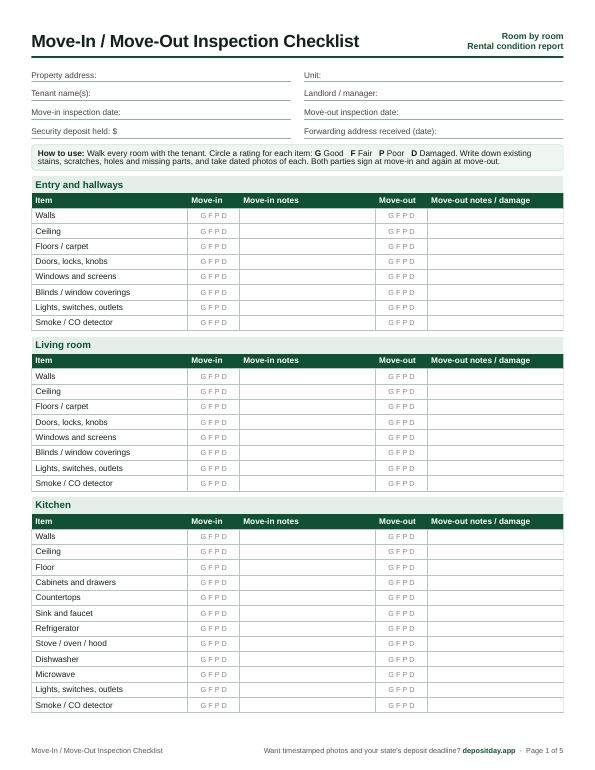
Room-by-room condition report: 12 rooms, 99 items, move-in and move-out columns, signature lines, and tips that win deposit disputes. Fill in the move-out column right next to the move-in notes. PDF, 5 pages, no sign-up.
Download the free PDF
The move-out inspection checklist, room by room
Walk the rooms in the same order as the move-in inspection. Mark each item Same, Worn (normal wear) or Damaged, and photograph anything that isn't the same.
Entry, halls and stairs
Front door, locks and deadbolt; doorbell and peephole; walls and ceiling; floor or carpet; light fixtures and switches; closet doors and shelves; smoke and CO detectors (press the test button); stair rails.
Living and dining rooms
Walls, ceiling and paint; carpet, floors and baseboards; windows, latches and screens; blinds and curtain rods; outlets, switches and light fixtures; ceiling fan; fireplace; doors and closets.
Kitchen
Refrigerator and freezer (inside, door seals, shelves, ice maker); stove, oven and range hood; dishwasher; built-in microwave; sink, faucet, disposal and leaks under the sink; countertops (burns, cuts, stains); cabinets, drawers and hinges; floor; walls behind the appliances.
Bathrooms
Toilet (flush, seat, tank, base); tub or shower (chips, grout, caulk, how fast it drains); sink, faucet and vanity; mirror and medicine cabinet; towel bars and paper holder; exhaust fan; tile; floor (soft spots, water damage); mold or mildew.
Bedrooms
Walls (holes, wall anchors, tape, marks); ceiling; carpet or floor; closet doors, tracks, rods and shelves; windows, screens and blinds; outlets and lights; door and lock.
Laundry and utility areas
Washer and dryer if supplied; hookups and dryer vent; water heater area (leaks); furnace or air handler and its filter (if the lease made the tenant responsible); floor drain.
Outside, garage and yard
Garage door and remote; oil stains on the driveway or garage floor; patio, deck or balcony; fences and gates; lawn and landscaping (if the lease made the tenant responsible); trash or items left behind; exterior doors and screens; mailbox.
Keys, meters and paperwork
Keys, fobs, garage remotes and mailbox keys returned (count them against move-in); a reading from each utility meter; thermostat working; the tenant's forwarding address in writing; the date and time the keys came back.
How to do the move-out inspection, step by step
- Wait until the unit is empty and the keys are back. Count every key, fob and remote against the move-in report (lock charges). Furniture hides carpet stains, wall damage and floor scratches. Write down the date and time you got possession back; in many states the deposit deadline counts from move-out.
- Bring the signed move-in report and photos. You're looking for change, not perfection. A stain listed at move-in isn't a deduction.
- Go in daylight and turn on every light. Dents, patches and stains show up at an angle.
- Test, don't just look. Run every faucet and the shower, flush each toilet, open and lock every window and door, run the dishwasher and disposal, light each burner and the oven, press each smoke alarm's test button, and try the garage remote.
- Photograph in pairs. A wide shot of the room from the doorway, then a close-up of each problem with a coin or tape measure for scale. Match the angles of the move-in photos.
- Describe damage so a stranger could picture it. "3-inch burn on the counter left of the sink" beats "counter damaged".
- Keep cleaning separate from damage. Dirt is a cleaning charge; a broken shelf is a repair. They're separate lines on the itemized statement.
- Sign and date the report. If the tenant is there, have them sign too, or note that they declined. Give them a copy.
- Price each item and send the itemized statement before your state's deadline.
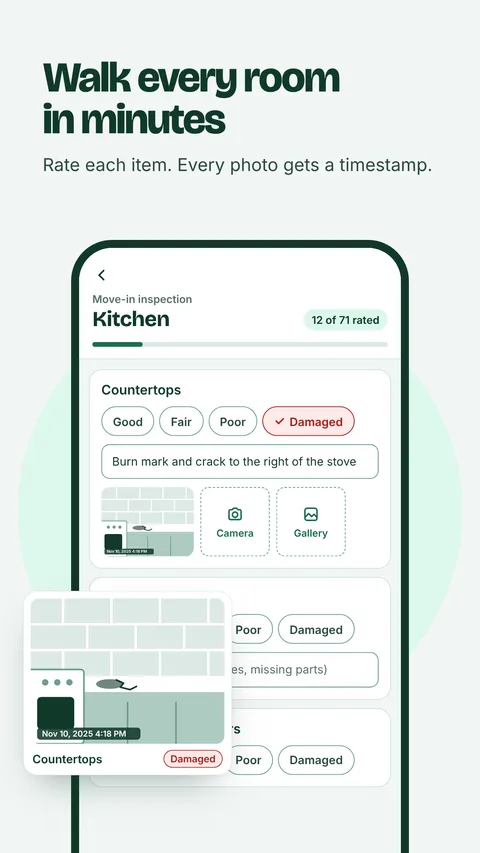
Normal wear and tear or damage?
A landlord can't charge for the ordinary aging of a home. Faded paint, matted carpet in walkways and a few small nail holes are normal wear. Large holes, burns, pet stains and broken fixtures are damage. Even for damage, the charge should reflect the item's age: a carpet near the end of its life has little value left. See the full room-by-room list in wear and tear vs. damage and run the numbers with the depreciation calculator.
Photos that hold up in a dispute
Dated photos are the strongest evidence either side has. The date and time should be on the image or in its file data, and you should keep the originals, not just screenshots. Shoot the same angles as the move-in photos. A slow, narrated video of every room takes five minutes and catches what photos miss. In California, a landlord deducting for repairs or cleaning must photograph the unit after the tenant leaves and again after the work (details below).
States with move-out inspection rules
Arizona
At move-in the landlord must give the tenant a move-in form for listing existing damage and written notice that the tenant may be present at the move-out inspection. If the tenant asks, the landlord must say when the move-out inspection will happen. (A.R.S. § 33-1321(C))
California
Once either side gives notice, the landlord must tell the tenant in writing that they can ask for an initial inspection, held no earlier than two weeks before the tenancy ends, with a list of proposed repairs or cleaning the tenant can take care of before leaving. Since April 1, 2025, a landlord deducting for repairs or cleaning must take photos after the tenant leaves (before the work) and again after it, and send them with the itemized statement. (Cal. Civ. Code § 1950.5)
Georgia
Within three business days after the lease ends and the tenant moves out (or surrenders the unit), the landlord must inspect and make a comprehensive list of any damage that will be charged against the deposit, with its estimated dollar value. On request, the tenant can inspect the unit and the list within five business days. A tenant who disagrees signs a written statement naming the items they dispute. Owners who, with their spouse and minor children, own ten or fewer units and manage them without a paid manager are exempt. (O.C.G.A. §§ 44-7-33, 44-7-36)
Kentucky
Where the statute applies (cities and counties that adopted the Uniform Residential Landlord and Tenant Act), the landlord must inspect at the end of the tenancy and list any damage to be charged against the deposit with the estimated repair cost. The tenant can inspect to check the list, and both sign it; a tenant who disagrees signs a written list of the items they dispute. (KRS 383.580)
Maryland
A tenant who notifies the landlord by certified mail at least 15 days before moving, with the move date and new address, has the right to be present at the move-out inspection. The landlord must hold it within 5 days before or after that move date and tell the tenant the date in writing. (Md. Code, Real Prop. §§ 8-203, 8-203.1)
New York
After the tenant gives notice, the landlord must offer an inspection before the tenant moves out, so the tenant can fix problems first. (N.Y. Gen. Oblig. Law § 7-108)
Virginia
The landlord must inspect within 72 hours after getting possession back, and the tenant can be present if they ask in writing. (Va. Code § 55.1-1226)
Washington
A landlord needs a signed move-in condition checklist before keeping any of the deposit, and the move-out deduction statement must include documentation such as receipts or invoices. (RCW 59.18.260, 59.18.280)
Other states may have no inspection statute, but every state's deposit rules still apply. Look up your state's deadline and rules.
Tenants: do your own move-out inspection
Don't rely only on the landlord's walkthrough. Once your things are out and the place is clean, walk every room with this list and take dated photos and a video. Ask for a walkthrough before you leave; some states require the landlord to offer one (pre-move-out inspection). Use the move-out cleaning checklist first. Return every key and get the return date in writing, and give your forwarding address in writing. If you're charged for something your photos disprove, those photos back up your demand letter.
Landlords: from inspection to itemized statement
Turn each Damaged line into a deduction with a cost: an invoice, a receipt or a written estimate, reduced for the item's age where it was near the end of its life. Add unpaid rent, utility bills in your name that the lease passes to the tenant, and cleaning beyond a normal turnover. Send the itemized statement and any balance before your state's deadline, which runs from 14 to 60 days; missing it can cost you the right to keep anything. Use the deduction letter template and check what landlords can deduct. Before the tenant leaves, a move-out letter sets expectations and cuts down on surprises. Rent for a partial last month: prorated rent calculator.
DepositDay puts the move-in report next to the move-out one, room by room, burns the date and time into every photo, flags what changed, counts down your state's deadline, and writes the itemized deduction letter for landlords or the demand letter for renters.
Start a free inspection
Common questions
What is a move-out inspection?
A walkthrough of the rental after the tenant moves out to record its condition, checked against the move-in report. It's the basis for any security deposit deduction for damage or cleaning.
Is a move-out inspection required?
In some states. Georgia, Kentucky (where its statute applies) and Virginia require the landlord to inspect, and Arizona and Maryland give tenants the right to be present. Where no statute requires it, skipping it leaves a landlord little to back up a deduction.
Can the tenant be present at the move-out inspection?
By law in Arizona, in Maryland (with 15 days' notice by certified mail) and in Virginia (on written request). In Georgia and Kentucky the tenant can inspect the unit to check the landlord's damage list. Anywhere else, ask in writing; many landlords agree.
How soon after move-out does a landlord have to inspect?
Georgia: within three business days. Virginia: within 72 hours. Maryland: within 5 days before or after the move date when the tenant gave notice. Where there's no inspection deadline, the deposit return deadline (14 to 60 days) still runs, so inspect within a day or two.
What should I bring to a move-out inspection?
The signed move-in report and photos, the lease, a phone for dated photos and video, a flashlight, and a coin or tape measure for scale.
What if there was no move-in inspection?
Then neither side has a baseline, and it's harder to show a problem is new. Dated move-out photos, emails or texts about the unit's condition, and repair records become the main evidence.
Related guides
General information, not legal advice. State and local rules differ and change. Read your state statute or ask a local attorney before you act. Deposit rules by state.