Deposit rules › Deposit limits by state
Security Deposit Limits by State (2026)
Maximum security deposit, every state
| State | Deposit limit |
|---|---|
| Alabama | 1 month's rent (more for pets, alterations, added risk) |
| Alaska | 2 months; no cap if rent over $2,000/mo |
| Arizona | 1.5 months |
| Arkansas | 2 months |
| California | 1 month (2 for some small landlords) |
| Colorado | 2 months |
| Connecticut | 2 months; 1 month for tenants 62+ |
| Delaware | 1 month for leases of 1 year+ |
| District of Columbia | 1 month |
| Florida | No cap |
| Georgia | 2 months (leases signed or renewed since July 1, 2024) |
| Hawaii | 1 month, plus optional pet deposit up to 1 month |
| Idaho | No cap |
| Illinois | No cap |
| Indiana | No cap |
| Iowa | 2 months |
| Kansas | 1 month unfurnished, 1.5 furnished, plus up to 1/2 month for pets |
| Kentucky | No cap |
| Louisiana | No cap |
| Maine | 2 months |
| Maryland | 1 month (2 in a narrow utility-assistance case) |
| Massachusetts | 1 month |
| Michigan | 1.5 months |
| Minnesota | No cap |
| Mississippi | No cap |
| Missouri | 2 months (pet deposits not included) |
| Montana | No cap |
| Nebraska | 1 month, plus pet deposit up to 1/4 month |
| Nevada | 3 months incl. last month's rent and any surety bond |
| New Hampshire | 1 month or $100, whichever is greater |
| New Jersey | 1.5 months |
| New Mexico | 1 month for leases under 1 year |
| New York | 1 month |
| North Carolina | 2 weeks (weekly), 1.5 months (monthly), 2 months (longer terms) |
| North Dakota | 1 month (2 in limited cases), plus pet deposit |
| Ohio | No cap |
| Oklahoma | No cap |
| Oregon | No cap (limits on adding a deposit in the first year) |
| Pennsylvania | 2 months in year one; 1 month from year two |
| Rhode Island | 1 month (separate furniture deposit allowed) |
| South Carolina | No cap |
| South Dakota | 1 month (more by agreement for special conditions) |
| Tennessee | No cap |
| Texas | No cap |
| Utah | No cap |
| Vermont | No cap |
| Virginia | 2 months |
| Washington | No cap |
| West Virginia | No cap |
| Wisconsin | No cap |
| Wyoming | No cap |
What counts toward the limit
In many capped states, the limit covers the security deposit plus other refundable money held at move-in, and sometimes prepaid rent beyond the first month. Pet deposits may or may not count, depending on the state. Non-refundable fees are treated differently from state to state; some treat them as part of the deposit. When in doubt, add up everything collected at move-in other than the first month's rent and compare it to your state's limit.
Cities can set their own rules
Some cities limit deposits further or add interest and holding requirements. Check your city's housing or rental ordinance as well as the state law.
Can the deposit go up later?
Not mid-lease without the lease allowing it or your agreement, and never above the cap. When a landlord can increase a security deposit.
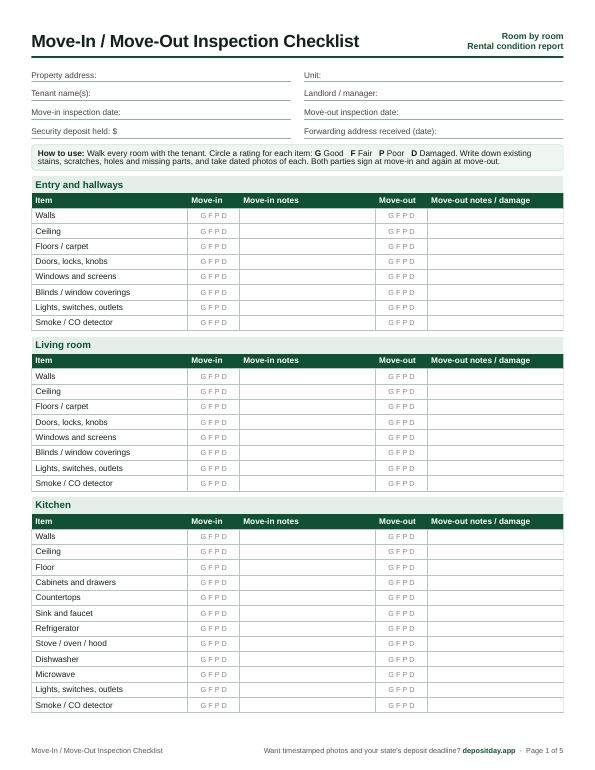
Room-by-room condition report: 12 rooms, 99 items, move-in and move-out columns, signature lines, and tips that win deposit disputes. Works in every state. PDF, 5 pages, no sign-up.
Download the free PDF
DepositDay walks you through move-in and move-out room by room, burns the date and time into every photo, shows what changed side by side, counts down your state's deadline, and writes the itemized deduction letter.
Start a free inspection
Common questions
Is there a limit on how much a landlord can charge for a security deposit?
It depends on the state. By our count, 29 states and D.C. set a maximum in their deposit statute, usually one to two months' rent, and 21 set no statewide cap. Some cities add their own limits.
What is the most common security deposit limit?
One or two months' rent. Some states allow more for furnished units, pets, or tenants with added risk, and some set lower limits for older tenants.
Can a landlord charge first, last and a security deposit?
In many states, yes, but in states with a cap, prepaid rent beyond the first month may count toward the limit. Check your state's rule.
What if my landlord charged more than the legal limit?
Ask in writing for the excess back, citing your state's statute. Many states set penalties for collecting more than allowed.
More deposit guides
Last reviewed November 2026. Summaries of each state's deposit statute, cross-checked against multiple published sources. General information, not legal advice.
© 2026 DepositDay · App · Free checklist · Pinterest · About · Contact · Privacy