Wear and tear vs. damage › Can a Landlord Charge for Pest Control
Can a Landlord Charge for Pest Control?
Who usually pays
Generally the landlord's cost
Not chargeable Pests present before the tenant moved in, pests coming from neighboring units, walls or the outside, routine preventive spraying, and treatment of common areas. Many states write this into their habitability rules. California, for example, requires the building and grounds to be free of "rodents, and vermin" at the start of the lease, and areas the landlord controls to be kept that way. (Cal. Civ. Code § 1941.1(a)(6))
Can be charged to the tenant
Chargeable An infestation the tenant caused, such as roaches or rodents drawn by trash and food left in the unit, fleas from a pet when the lease requires treatment, or bed bugs brought in on infested furniture. Treatment that failed or had to be repeated because the tenant refused access or wouldn't follow the treatment steps can also fall on the tenant.
Bed bug rules in three states
California
A landlord can't show, rent or lease a vacant unit the landlord knows has a current bed bug infestation. Landlords must give new tenants a written bed bug notice with information on identification, prevention and how to report a suspected infestation. Tenants must cooperate with inspections, including giving the pest control operator information it asks for. (Cal. Civ. Code §§ 1954.602, 1954.603, 1954.604)
Arizona
Landlords must give tenants bed bug educational materials and can't enter a lease for a unit they know has a current infestation. Tenants can't knowingly move infested materials into a unit and must tell the landlord in writing or electronically when they know of bed bugs. The section doesn't apply to single-family homes. (Ariz. Rev. Stat. § 33-1319)
Maine
Within 5 days of a tenant's notice, the landlord must inspect for bed bugs, and within 10 days of finding an infestation, contact a pest control agent, who must be insured and must promptly treat it. Tenants must report suspected bed bugs, allow access and follow reasonable control measures. A tenant who unreasonably fails to comply is responsible for the treatments that result. If a tenant can't do the preparation work, the landlord must offer reasonable help and may charge a reasonable amount, repayable over up to 6 months unless both agree to longer. (14 M.R.S. § 6021-A)
Other states and many cities have their own rules. Look up your state.
Making a pest charge hold up
Landlords: document the unit at move-in, with dated photos showing clean cabinets, floors and baseboards. At move-out, photograph droppings, trash or infested items before cleanup, and keep the pest control company's report saying what they found and treated. Itemize the charge with the invoice. Charging every departing tenant a flat "pest control fee" is hard to defend when there's no infestation. Renters: report pests in writing as soon as you see them, keep a copy, and let the landlord in for treatment. A written report that pests appeared early, or came from next door, is your best answer to a move-out charge.
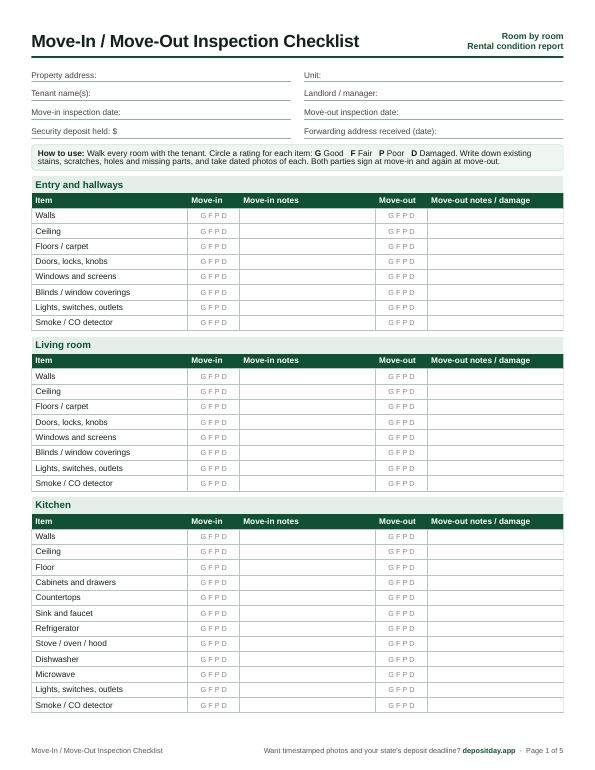
Room-by-room condition report: 12 rooms, 99 items, move-in and move-out columns, signature lines, and tips that win deposit disputes. Fill it in at move-in so the move-out comparison is easy. PDF, 5 pages, no sign-up.
Download the free PDF
Before anyone deducts
Every state sets a deadline for returning the deposit or sending an itemized list of deductions, from 14 to 60 days. Missing it can cost the landlord the right to keep anything. Look up your state. Landlords: use the free deduction letter template. Renters: see how to get your deposit back.
DepositDay walks you through move-in and move-out room by room, burns the date and time into every photo, shows what changed side by side, counts down your state's deadline, and writes the itemized deduction letter.
Start a free inspection
Common questions
Can a landlord charge for pest control when I move out?
Only if you caused or worsened the infestation, for example by leaving garbage behind or bringing in infested furniture. Routine pest control and pests you didn't cause are generally the landlord's cost.
Who pays for bed bug treatment, the landlord or the tenant?
Usually the landlord, unless the tenant brought them in or didn't cooperate with treatment. Maine makes a tenant who unreasonably fails to comply with control measures responsible for the resulting treatments.
Can my lease require me to pay for pest control?
Some leases do, but a lease clause generally can't override a state's habitability rules. A clause charging every tenant for routine spraying is weaker than a charge for an infestation the tenant caused.
Is a flea treatment charge legal after I move out with a pet?
Often, if the lease requires it or fleas were actually left behind. The charge should be itemized and match a real invoice. The pet damage guide covers more.
More deposit guides
General information, not legal advice. State and local rules differ and change. Read your state statute or ask a local attorney before you act. Deposit rules by state.
© 2026 DepositDay · App · Free checklist · Pinterest · About · Contact · Privacy