Deposit rules › Interest by state
Security Deposit Interest by State (2026)
States that require interest
Connecticut (Gen. Stat. 47a-21)
Applies to: Most landlords (school-run student housing exempt).
Rate: Set yearly by the state banking department (0.49% for 2026).
When paid: Each tenancy anniversary, paid or credited to rent; within 21 days if you move out sooner.
District of Columbia (14 DCMR 311)
Applies to: Tenancies of 12 months or more.
Rate: At least the savings rate at the D.C. bank holding the deposit, reset each January 1 and July 1.
When paid: With the deposit at move-out.
Florida (Fla. Stat. 83.49)
Applies to: Only deposits in an interest-bearing account or covered by a surety bond.
Rate: Account: 75% of the account's rate or 5% simple, landlord's choice. Bond: 5% simple.
When paid: At least yearly, paid or credited to rent.
Illinois (765 ILCS 715)
Applies to: Buildings with 25+ units; deposits held over 6 months.
Rate: Passbook savings rate of the state's largest bank on December 31 before the lease began.
When paid: Within 30 days after each lease year; the rest at move-out.
Maryland (Real Prop. 8-203)
Applies to: Deposits of $50 or more held at least 6 months.
Rate: The greater of the 1-year Treasury rate on the year's first business day or 1.5% (3.47% for 2026).
When paid: With the deposit, within 45 days after the tenancy ends.
Massachusetts (G.L. c. 186, s. 15B)
Applies to: Deposits held 1+ year, plus prepaid last month's rent.
Rate: 5%, or less if the bank paid less.
When paid: End of each tenancy year, paid or as a rent credit.
Minnesota (Stat. 504B.178)
Applies to: All deposits.
Rate: 1% simple.
When paid: With the deposit refund.
New Hampshire (RSA 540-A:6)
Applies to: Deposits held 1+ year. Some small owner-occupied buildings and single-home owners are exempt.
Rate: The savings rate at the bank holding the deposit.
When paid: With the deposit; tenants can also request it every 3 years.
New Jersey (N.J.S.A. 46:8-19)
Applies to: Most rentals. Owner-occupied 2- or 3-family homes exempt unless the tenant opts in.
Rate: Whatever the required account earns.
When paid: Each lease anniversary or renewal, paid or credited to rent.
New Mexico (NMSA 47-8-18)
Applies to: Annual leases with a deposit above one month's rent.
Rate: A passbook rate named in the statute (the board that set it no longer exists; ask the landlord which rate is used).
When paid: Each year.
New York (Gen. Oblig. Law 7-103)
Applies to: Buildings with 6+ units, and any deposit placed in an interest-bearing account.
Rate: What the account earns, minus a 1% yearly fee the landlord may keep.
When paid: Yearly as a rent credit, or when the lease ends.
North Dakota (Cent. Code 47-16-07.1)
Applies to: Occupancy of 9+ months.
Rate: Whatever the required insured account earns.
When paid: With the deposit at the end of the lease.
Ohio (Rev. Code 5321.16)
Applies to: The part of the deposit above the greater of $50 or one month's rent, for stays of 6+ months.
Rate: 5%.
When paid: Each year.
Pennsylvania (68 P.S. 250.511b)
Applies to: Deposits over $100, starting at the deposit's second anniversary.
Rate: What the account earns, minus a 1% yearly fee.
When paid: Each year on the lease anniversary.
Cities with their own rules
Chicago requires interest on deposits held over 6 months, at a rate the city sets each year. San Francisco requires interest on deposits held over a year. Los Angeles requires it for rent-stabilized units (3.03% for 2026). California, Virginia and most other states have no statewide rule, so check your city.
How to calculate it
Simple interest is deposit × rate × years. A $1,500 deposit held 2 years at 1% earns $30. Where the rate resets yearly, figure each year at that year's rate and add them up. Where the rule says "what the account earns," the bank statement is the answer. Some states also control where the deposit is kept: see where landlords must hold deposits.
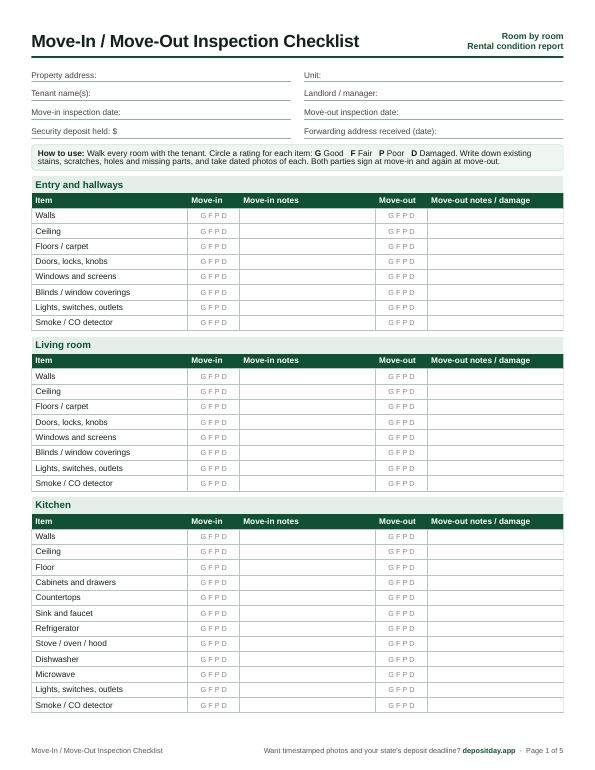
Room-by-room condition report: 12 rooms, 99 items, move-in and move-out columns, signature lines, and tips that win deposit disputes. Works in every state. PDF, 5 pages, no sign-up.
Download the free PDF
Renters: how to ask for it
Ask in writing with your move-out notice or your deposit demand letter. Name the statute, the deposit amount, the dates and the rate. Most landlords who owe it pay once asked.
DepositDay walks you through move-in and move-out room by room, burns the date and time into every photo, shows what changed side by side, counts down your state's deadline, and writes the itemized deduction letter.
Start a free inspection
Common questions
Do landlords have to pay interest on security deposits?
Only in some places. Thirteen states and Washington, D.C. require interest on at least some deposits, and some cities, such as Chicago, San Francisco and Los Angeles (rent-stabilized units), add their own rules. Most states have no interest requirement.
How do I calculate security deposit interest?
For simple interest, multiply the deposit by the yearly rate and by the number of years held. A $1,500 deposit held 2 years at 1% is $1,500 × 0.01 × 2 = $30. States with rates that change yearly figure each year at its own rate.
What happens if the landlord doesn't pay the interest?
It depends on the state. In some, failing to pay required interest is treated like wrongfully withholding the deposit, which can bring penalties. Ask for it in writing first, then check your state's statute.
Does Kansas or Missouri require deposit interest?
No. Neither Kansas nor Missouri requires landlords to pay interest on security deposits.
More deposit guides
Last reviewed November 2026. Summaries of each statute; rates that change yearly are shown for 2026. General information, not legal advice. Read the statute or ask a local attorney before you act.
© 2026 DepositDay · App · Free checklist · Pinterest · About · Contact · Privacy