The federal rule in plain terms
The voucher program's deposit rule is short. Under 24 CFR 982.313:
Collecting the deposit
The owner may collect a security deposit from the tenant. The PHA may prohibit deposits that exceed private market practice, or that exceed what the owner charges unassisted tenants. The HUD tenancy addendum that's part of every voucher lease repeats this and says any such PHA restriction must be written into the housing assistance payments (HAP) contract.
Using the deposit at move-out
Subject to state or local law, the owner may use the deposit, including any interest on it, as the lease allows, to cover unpaid rent the tenant owes, damage to the unit, or other amounts the tenant owes under the lease.
Itemizing and refunding
The owner must give the tenant a written list of all items charged against the deposit and the amount of each. After deducting, the owner must promptly refund the full unused balance to the tenant. If the deposit doesn't cover everything the tenant owes, the owner may try to collect the balance from the tenant.
State law still applies
A voucher doesn't replace your state's deposit law. Federal rules say the landlord uses the deposit "subject to State or local law," so the state's deposit limit, return deadline, itemization rules, interest requirements and penalties all still apply. If the PHA sets a lower cap, the lower one controls for that tenancy. Check deposit limits by state, the return deadline for your state, and whether your state requires interest on deposits.
Who pays the deposit?
The tenant does, in the standard program. The housing assistance payment covers part of the monthly rent, not the deposit. Some housing authorities do help: HUD's PIH Notice 2022-18 lets PHAs use voucher administrative fees for security deposit assistance. The amount can't exceed the actual deposit the owner requires or the most state or local law allows. The PHA can pay it straight to the owner, or to the family after confirming the family paid it, and it may require that the deposit assistance be returned to the PHA at the end of the tenancy, less amounts the owner keeps under the lease. Whether your PHA offers this, and on what terms, is up to that PHA, so ask your caseworker before you sign.
What a landlord can and can't deduct
Usually OK The tenant's own share of rent that went unpaid.
Usually OK Damage beyond normal wear and tear, priced fairly and reduced for age (depreciation calculator).
Usually OK Other amounts the lease makes the tenant responsible for, like a utility bill in the landlord's name, if state law allows the deduction.
Problem The housing authority's share of the rent. Under 24 CFR 982.451, the family isn't responsible for the part of the rent covered by the housing assistance payment, so that part isn't rent the tenant owes.
Problem Charges with no written list, or a lump sum with no amount per item. The federal rule requires each item and its amount.
Problem Anything your state doesn't allow, such as normal wear and tear.
If the owner loses the property to foreclosure, the new owner takes it subject to your lease and the housing assistance payments contract under federal law. See security deposits in a foreclosure.
Public housing is different
In public housing, the housing authority is the landlord. Its lease may require a deposit, but the deposit can't be more than one month's rent or a reasonable fixed amount the PHA sets, and the PHA may let tenants pay it gradually (24 CFR 966.4). Subject to applicable law, interest earned on deposits may be refunded to the tenant at move-out or used for tenant services or activities.
Landlords: move-out with a voucher tenant
Do a normal move-in inspection and keep it with the PHA's own inspection report; they're separate. At move-out, inspect, photograph, and send the itemized list within your state's deadline. Keep the tenant's share and the PHA's share separate in your ledger so the unpaid-rent line shows only what the tenant owed. Questions about the HAP contract, abatements or a PHA's unpaid share go to the PHA, not the tenant's deposit. Use the deduction letter template and the move-out inspection checklist.
Tenants: protect your deposit
Get a receipt for the deposit (sample receipt). Do your own move-in walkthrough with dated photos, even though the PHA also inspects; the PHA checks housing quality standards, not who caused a stain. Before moving out, clean, take dated photos and video, return keys, and give your forwarding address in writing. If you're moving with your voucher, ask your caseworker early whether deposit help is available for the new unit, since your old deposit may not come back until after your new lease starts. If charges look wrong, send a demand letter, and contact your local legal aid office or the PHA if the landlord won't respond.
Sources: 24 CFR 982.313 (security deposit: amounts owed by tenant), 24 CFR 982.451 (HAP contract; family not responsible for the assistance payment's share of rent), 24 CFR 966.4(b)(5) (public housing deposits), via ecfr.gov; HUD Tenancy Addendum, form HUD-52641-A, section 15; HUD PIH Notice 2022-18 (security deposit assistance from administrative fees), hud.gov. Housing authority policies vary; ask your PHA for its rules.
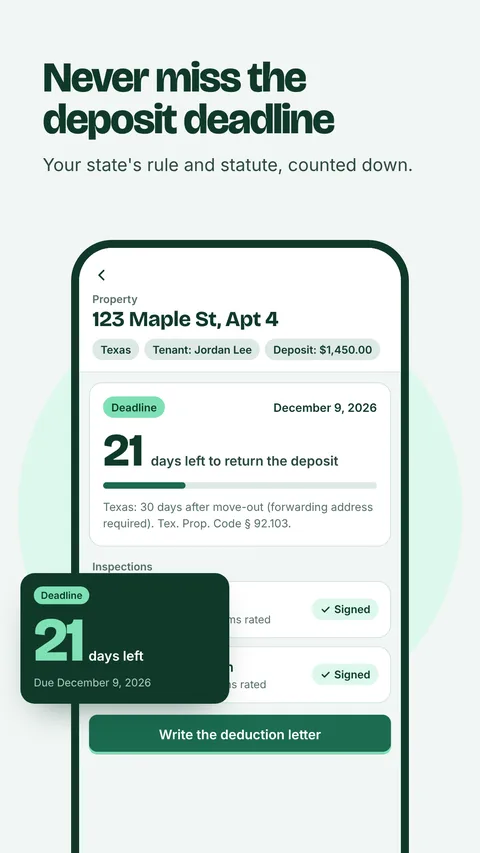
DepositDay walks you through every room, burns the date and time into each photo, and counts down your state's deadline so you know exactly when your landlord owes you. Free, no account.
Start a free move-out walkthrough
Common questions
Does Section 8 pay the security deposit?
Usually not. The tenant pays the deposit in the standard voucher program. Some housing authorities offer deposit assistance using administrative fees, as HUD's PIH Notice 2022-18 allows, so ask yours.
Can a landlord charge a Section 8 tenant a higher security deposit?
The housing authority may prohibit a deposit above local market practice or above what the landlord charges unassisted tenants, and state deposit limits still apply.
Can a landlord keep a Section 8 tenant's deposit for unpaid rent?
For the tenant's own unpaid share, yes, subject to state law. The family isn't responsible for the part of the rent the housing assistance payment covers.
How long does a landlord have to return a Section 8 deposit?
Federal rules say to refund the unused balance promptly with a written list of charges. The actual deadline comes from your state's deposit law.
How much is the security deposit in public housing?
No more than one month's rent or a reasonable fixed amount set by the housing authority, and the PHA may let tenants pay it over time.
Does the PHA inspection count as a move-in inspection?
Not for deposit purposes. The PHA inspects for housing quality standards. Landlord and tenant should still do and sign their own move-in condition report.
Related guides
General information, not legal advice. State and local rules differ and change. Read your state statute or ask a local attorney before you act. Deposit rules by state.