A new job doesn't end the lease by itself
A fixed-term lease is a promise to pay rent for the whole term. A transfer, a promotion in another city or a new job across the country doesn't cancel it. If you leave early, the landlord can charge what the lease and your state's law allow and apply your security deposit to it. The ways out come from four places: the lease itself, a state statute, federal law for servicemembers, or a deal you make with the landlord.
Delaware: an employer transfer of more than 30 miles
Delaware's landlord-tenant code lets a tenant end the tenancy on 30 days' written notice when a change in the location of their job with their present employer requires moving their home more than 30 miles (25 Del. C. § 5314(b)(1)). Two details matter. A job with a new employer doesn't qualify. And the statute doesn't say where the 30 miles is measured from, so keep a record of the old and new addresses.
The timing is unusual. The 30 days begin on the first day of the month after the landlord actually gets your notice. Notice delivered May 28 starts the clock June 1, so the tenancy ends June 30. Notice delivered June 2 starts it July 1, and you pay about a month more. Get the letter in before the 1st.
Once the tenancy is rightfully ended, both sides' duties under the lease stop and any remaining obligations get settled as soon as practicable (§ 5314(a)). The statute doesn't list documents, but attaching a letter from your employer with the new work location heads off an argument. The same section covers other exits too: serious illness, moving into senior or subsidized housing, active military duty, domestic abuse, sexual offenses or stalking, and a tenant's death.
Check your lease for an early termination clause
Search the lease for "early termination," "buyout," "relocation," "transfer" and "liquidated damages." Some leases let you leave with a set amount of notice and a fee, usually stated in months of rent. A clear clause replaces the open-ended rent-until-re-rented math with a number you can budget for. In Florida, a fee like that is capped at 2 months' rent, needs a separate signed addendum, and the lease can require no more than 60 days' notice to use it (Fla. Stat. § 83.595(4)).
No clause? Ask anyway. A written buyout offer, say one month's rent plus help finding the next tenant, often beats a vacant unit for the landlord. Get any deal in writing and signed, with the date the lease ends and what happens to the deposit.
Sublet, assign or bring a replacement tenant
Handing the lease to someone else can cut what you owe to nothing, but know which one you're doing. Assignment transfers the lease to a new tenant. Subletting keeps you on the lease while someone else lives there and pays you, so you're still on the hook if they stop. Many leases require the landlord's written consent for either.
New York
You need the landlord's written consent to assign, and the landlord can say no. If the refusal is unreasonable, the landlord must release you from the lease on 30 days' notice when you ask, and that release is your only remedy. In buildings with four or more units, you have a right to sublet with the landlord's consent, which can't be unreasonably withheld. Send the request by certified mail with the details the law lists. The landlord has 10 days to ask for more information and 30 days to answer, and no answer counts as consent. You stay liable on the lease while the subtenant lives there (N.Y. Real Prop. Law § 226-b). Rent-stabilized apartments follow extra rules.
California
A lease can let the landlord keep it in force after you leave and collect rent as it comes due, but only if it also lets you sublet or assign, subject to reasonable limits (Cal. Civ. Code § 1951.4). Under a clause like that, a qualified replacement is the fastest way to stop paying rent out of pocket.
The landlord's duty to re-rent caps what you owe
Where state law makes the landlord try to re-rent, you owe rent only for the time the unit sits empty despite reasonable efforts, plus, in some states, reasonable re-renting costs such as advertising. Texas (Tex. Prop. Code § 91.006), New York (N.Y. Real Prop. Law § 227-e) and Illinois (735 ILCS 5/9-213.1) impose that duty. California limits a landlord who ends the lease to rent losses you can't show could reasonably have been avoided (Cal. Civ. Code § 1951.2). Florida lets the landlord choose among set options, one of which is charging rent as it comes due, so the lease matters more there (Fla. Stat. § 83.595).
Tell the landlord your move-out date early, offer to make the unit easy to show, and ask in writing what's being done to re-rent. The full breakdown is in breaking a lease and your deposit.
Military orders are different
Servicemembers with permanent change of station orders, or orders to deploy for 90 days or more, can end a lease under federal law with written notice and a copy of the orders, and the landlord can't charge an early termination fee (military orders and your deposit). That rule covers servicemembers and their dependents, not civilian job transfers.
Ask your employer before you pay
Relocation packages sometimes cover a lease-break fee or a month of double rent. Ask HR before you sign a buyout, and get a receipt from the landlord that names the charge, since reimbursement usually needs one. A letter confirming the transfer helps in Delaware and in any buyout talk.
A worked example
Lease: 12 months at $1,800, deposit $1,800. The tenant's employer transfers them to another city. Written notice reaches the landlord on May 28, and the tenant moves out June 30 with six months, July through December ($10,800), left on the lease.
Lease has a buyout clause of 30 days' notice plus two months' rent: the tenant owes $3,600. The landlord applies the $1,800 deposit and bills the other $1,800, plus any damage beyond normal wear.
No clause, in Texas: the landlord re-lists right away and a new tenant starts paying August 15. The tenant owes July ($1,800), August 1 to 14 (14 of 31 days, $812.90) and $90 of advertising, a total of $2,702.90. After the deposit, the balance is $902.90.
Delaware, same employer, a move of more than 30 miles: notice delivered May 28 starts the 30 days on June 1, so the tenancy ends June 30. The tenant owes rent through June, nothing for July through December, and gets the deposit back minus any damage on Delaware's deadline.
Run your own dates through the prorated rent calculator.
How to give notice
- Put it in writing. Include the date, the rental address, your move-out date, the reason, and which exit you're using: the lease clause, the state statute, or a request for a buyout.
- Attach proof of the transfer when a statute or clause depends on it: a letter from your employer with the new work location and start date.
- Deliver it in a way you can prove, such as certified mail or email to the address in the lease, and keep a copy. In Delaware, the delivery date decides which month the 30 days start.
- Add your forwarding address for the deposit (why it matters). The notice to vacate letter builds the basic letter for you.
- Leave it clean and photographed. Dated photos of every room are what protect the deposit (move-out cleaning checklist).
What happens to your security deposit
Leaving for work doesn't forfeit the deposit. The landlord can apply it to rent you actually owe, a valid lease-break fee and damage beyond normal wear, then must return the rest or send an itemized statement by your state's deadline. If the statement charges rent for time after the unit was re-rented, or after a Delaware termination date, dispute it in writing.
Landlords: a tenant who's relocating
Ask which exit the tenant is using and get it in writing. In Delaware, look at the employer letter and work out the end date from the day you actually received the notice. Elsewhere, a quick buyout or an approved replacement tenant usually costs less than a vacancy and a collection fight. If the tenant just leaves, re-list at market rent right away and keep the listing history; where a duty to re-rent applies, that record supports the rent you bill. In New York buildings with four or more units, answer a written sublet request within 30 days, because silence counts as consent.
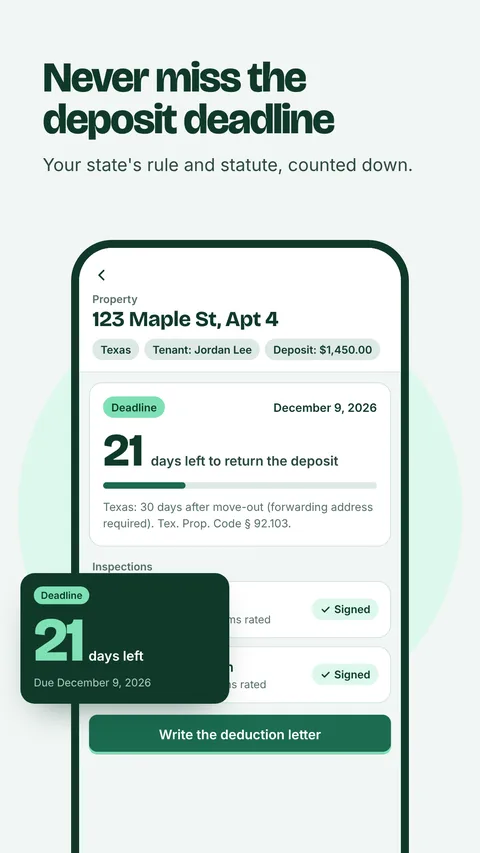
DepositDay walks you through every room, burns the date and time into each photo, and counts down your state's deadline so you know exactly when your landlord owes you. Free, no account.
Start a free move-out walkthrough
Common questions
Can I break my lease if I get a job in another state?
Yes, but you'll usually owe something: rent until the unit is re-rented, or a buyout fee if your lease has one. A state statute can give you a free exit, as Delaware's does for an employer transfer of more than 30 miles.
Is a job relocation a legal reason to break a lease?
Only where your lease or a state law says so. Delaware lets a tenant end the tenancy on 30 days' written notice when their present employer moves their job and they must relocate more than 30 miles. Military orders are covered by federal law.
Does a new job with a different employer count in Delaware?
No. The Delaware rule covers a change in the location of your job with your present employer that requires moving your home more than 30 miles.
How much notice do I need to give for a job relocation?
Whatever your lease's early termination clause requires; Florida caps that notice at 60 days. Under Delaware's statute, the 30 days start on the first day of the month after the landlord actually receives your notice.
Can my landlord refuse to let me sublet?
Often, if the lease requires consent. New York limits refusals: in buildings with four or more units, consent to a sublet can't be unreasonably withheld, and an unreasonable refusal to an assignment lets you ask to be released on 30 days' notice.
Will my employer pay my lease-break fee?
Only if your relocation package covers it. Ask HR before you agree to a buyout, and get a written receipt from the landlord that names the charge.
Related guides
General information, not legal advice. State and local rules differ and change. Read your state statute or ask a local attorney before you act. Deposit rules by state.