Who can end a lease under the SCRA
Section 3955 of the Servicemembers Civil Relief Act covers a lease of a home (or other premises) used or meant to be used by a servicemember or their dependents when one of these is true:
- The lease came first. The tenant signed the lease and then entered military service during its term.
- Orders came after the lease. The servicemember signed the lease while in service and then received orders for a permanent change of station (PCS), or to deploy with a unit or in support of a military operation, for at least 90 days. The law counts separation or retirement as a permanent change of station.
- Stop movement order. The servicemember signed a lease after getting PCS or deployment orders, and then a stop movement order of at least 30 days (or indefinite) kept them from moving in.
The SCRA covers servicemembers and their dependents. A civilian job transfer doesn't qualify; see breaking a lease for a job relocation for the options that do.
Ending the lease also ends any obligation a dependent has under it, so a spouse on a joint lease is released too. If a servicemember dies while in military service, the spouse or a dependent may end the lease within one year of the death. After a catastrophic injury or illness during service, the servicemember may end the lease within one year (a spouse or dependent can do it if the servicemember lacks the capacity to manage their affairs).
How to give notice
Deliver written notice of termination together with a copy of the military orders to the landlord or the landlord's agent. "Orders" can be official orders, including separation or retirement orders, or a letter or other written verification from the commanding officer about the servicemember's current or future duty status. The law allows hand delivery, a private carrier (like FedEx or UPS), U.S. mail with return receipt requested, or electronic delivery such as email to an address the landlord designated or a tenant portal. Keep proof of the delivery date: it starts the clock.
When the lease actually ends
For a lease with monthly rent, termination takes effect 30 days after the first date the next rent payment is due after the notice is delivered. For other leases, it takes effect on the last day of the month after the month the notice is delivered. For the stop movement situation, it takes effect when the notice requirements are met.
Example
Rent is due on the 1st. The tenant delivers notice and orders on March 10. The next rent due date after delivery is April 1, so the lease ends 30 days later, on May 1. The tenant owes rent through that date, prorated if needed, and nothing after it. If the tenant had already paid May's rent in advance, the landlord must refund it within 30 days of May 1. Use the prorated rent calculator for a partial month.
What the landlord can and can't take from the deposit
Can't
Not allowed An early termination fee or lease-break penalty. The statute says the landlord "may not impose an early termination charge."
Not allowed Rent for months after the termination date. The SCRA makes it a federal misdemeanor to knowingly hold a servicemember's security deposit (or belongings) to cover rent that accrues after a lawful termination.
Not allowed Keeping prepaid rent for any period after the termination date. It must be refunded within 30 days of the effective date.
Can
Usually allowed Unpaid rent up to the termination date, prorated.
Usually allowed Other amounts the tenant owes under the lease that are due and unpaid when the lease ends, such as a utility bill the lease makes the tenant's responsibility.
Usually allowed "Reasonable charges to the lessee for excess wear," which means damage beyond normal wear and tear, under your state's normal rules.
The SCRA doesn't set its own deadline for returning the security deposit. Your state's deposit law still controls the deadline, the itemized list of deductions, and any penalty for missing them. Look up your state's deadline.
Landlords: handling a military termination
Confirm the notice included orders or a commanding officer's letter, write down the delivery date, and work out the effective date from your rent due date. Bill rent only through that date. Don't add a lease-break fee, a re-letting fee or "rent until re-rented"; those apply to ordinary lease breaks (what normally happens when a tenant breaks a lease), not to an SCRA termination. Do a normal move-out inspection, deduct only damage beyond normal wear and amounts actually owed, and send the itemized statement before your state's deadline. A landlord who believes the termination is unfair can ask a court to modify the relief, but only by applying before the termination date. Use the deduction letter template so each charge has its own line.
Servicemembers: protect your deposit
- Send notice and orders the moment you have them. The earlier the notice, the earlier the lease ends.
- Use a delivery method you can prove: return receipt mail, a carrier with tracking, or email to the landlord's designated address.
- Ask for a walkthrough before you leave and fix what you can (pre-move-out inspection).
- Take dated photos and video of every room after you've cleaned and moved out, and give your forwarding address in writing. If you're deploying, give an address or email someone will check.
- Check the itemized statement for an early termination fee or rent past the termination date. Both are improper under the SCRA.
If the landlord keeps it anyway
Start with a written demand that cites 50 U.S.C. § 3955 and your state's deposit statute (free demand letter). Your installation's legal assistance office can help servicemembers and dependents with lease and deposit disputes at no cost. The SCRA also gives a person harmed by a violation the right to sue for damages and other relief, and a court may award costs and a reasonable attorney fee to a servicemember who wins. The U.S. Department of Justice also accepts SCRA complaints and can sue landlords over patterns of violations. For smaller amounts, small claims court is often the fastest route for the state-law deposit claim.
Sources: Servicemembers Civil Relief Act, 50 U.S.C. § 3955 (termination of residential leases: covered leases, notice, effective date, no early termination charge, refund of rent paid in advance, misdemeanor for holding a security deposit) and 50 U.S.C. § 4042 (private right of action), via govinfo.gov; U.S. Department of Justice, Servicemembers and Veterans Initiative (justice.gov/servicemembers). State deposit deadlines and penalties are on each state page.
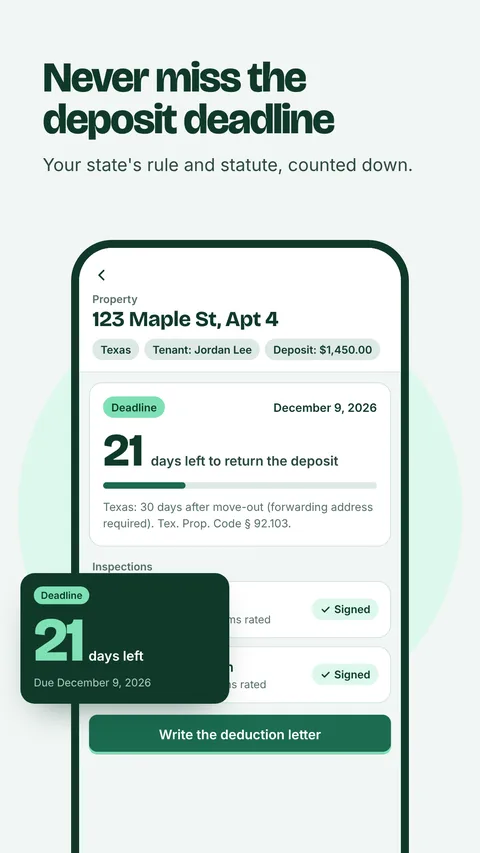
DepositDay walks you through every room, burns the date and time into each photo, and counts down your state's deadline so you know exactly when your landlord owes you. Free, no account.
Start a free move-out walkthrough
Common questions
Do I get my security deposit back if I break my lease for military orders?
Yes, under your state's normal deposit rules. The landlord can deduct prorated rent owed up to the termination date and damage beyond normal wear, but can't charge an early termination fee or hold the deposit for rent after the lease legally ends.
Can a landlord charge an early termination fee to a servicemember?
Not when the lease is ended under the SCRA. 50 U.S.C. § 3955 says the landlord may not impose an early termination charge.
When does my lease end after I give SCRA notice?
For monthly rent, 30 days after the next rent due date following delivery of your notice. Notice delivered March 10 with rent due on the 1st ends the lease May 1.
Does the SCRA set a deadline to return my security deposit?
No. It requires prepaid rent for the period after termination to be refunded within 30 days, but the security deposit deadline comes from your state's law.
What counts as military orders for breaking a lease?
Official orders, including separation or retirement orders, or a written notification or verification from your commanding officer about your current or future duty status.
Can my spouse end the lease too?
Your termination ends a dependent's obligations under the same lease. A spouse or dependent can also end the lease within one year if the servicemember dies in military service.
Related guides
General information, not legal advice. State and local rules differ and change. Read your state statute or ask a local attorney before you act. Deposit rules by state.