The IRS rules, in plain terms
Refundable security deposit
Not income yet "Don't include a security deposit in your income if you may be required to return it to the tenant at the end of the lease." Hold it, return it on time, and it never shows up on your tax return. (IRS Topic No. 414)
Deposit you keep
Income the year you keep it If you keep part or all of it because the tenant broke the lease and moved out early, or didn't live up to the lease in another way, include the amount you keep in income that year. If you keep it to pay for damage repairs, the IRS says to include it in the year you keep it if your practice is to deduct the cost of repairs as expenses. In that case the repair cost is usually a deductible expense, so the two can offset. (IRS Topic No. 414; IRS Rental Income and Expenses tips)
"Deposit" that is really last month's rent
Income when received "If an amount called a security deposit is to be used as a final payment of rent, it is advance rent." Advance rent is income in the year you receive it, no matter what period it covers or which accounting method you use. A December lease signing with first month's rent and last month's rent means both go on that year's return. (IRS Rental Income and Expenses tips)
Other move-in and move-out money
Lease-break or cancellation fees. If a tenant pays you to cancel a lease, the IRS treats it as rental income in the year you receive it.
Non-refundable fees. A cleaning fee, pet fee or other charge the tenant never gets back isn't a deposit at all, so it is generally income when received. See non-refundable deposits and fees and pet deposit vs. pet fee.
Tenant pays your expenses. If the tenant pays a bill that's yours, like a repair you owed or a utility in your name, the IRS treats it as rental income, and you may deduct the expense if it's deductible.
Why the label in the lease matters
Call it what it is. A lease that says "security deposit, refundable minus lawful deductions" is held money. A lease that says "last month's rent" is advance rent, taxed now, and in many states it can't be used for damage at all. Mixing the two causes problems with both the IRS and your state's deposit law. See deposit vs. last month's rent and deposit limits by state, since some states count prepaid rent toward the cap.
Interest on the deposit
Some states require landlords to pay tenants interest on deposits or to hold them in a separate or interest-bearing account. How that interest is taxed depends on who it belongs to and how the account is set up, so ask a tax professional. The state rules are on deposit interest by state and where deposits must be held, and the interest calculator does the math.
Keep records that match
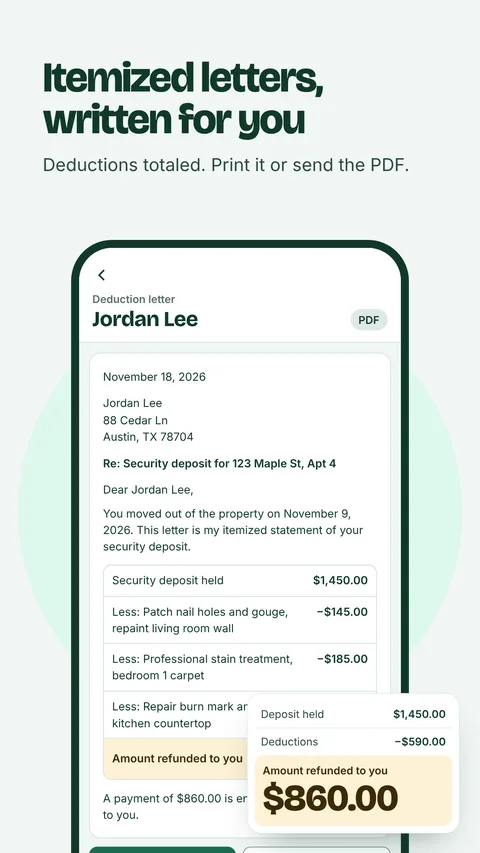
For each tenant, keep the lease, the deposit receipt, the move-in and move-out inspection, and the itemized deduction letter. The deduction letter shows exactly how much you kept and why, which is the number that goes into income for that year. Repair invoices for the same work support the expense side.
Sources: IRS Topic No. 414, Rental Income and Expenses (irs.gov/taxtopics/tc414); IRS, Rental Income and Expenses - Real Estate Tax Tips (irs.gov). Federal rules only. State income tax rules can differ. This is general information, not tax advice; ask a tax professional about your situation.
DepositDay walks you through move-in and move-out room by room, burns the date and time into every photo, shows what changed side by side, counts down your state's deadline, and writes the itemized deduction letter.
Start a free inspection
Common questions
Do landlords pay taxes on security deposits?
Not when the deposit is received, if the landlord may have to return it. The IRS says to include it in income only in the year the landlord keeps part or all of it, such as for unpaid rent, an early move-out or damage.
Is a security deposit used as last month's rent taxable?
Yes, in the year you receive it. The IRS treats a deposit that's meant to be used as the final rent payment as advance rent, which is income when received.
If I keep the deposit for repairs, is it income?
The IRS says to include the amount you keep in income that year if your practice is to deduct repair costs as expenses. The repair cost itself is then generally deductible, so the two can offset.
Does a tenant report a returned security deposit as income?
No. A returned deposit is the tenant's own money coming back. It isn't income to the tenant.
Is a non-refundable pet or cleaning fee taxable?
Generally yes, in the year received, because it isn't a refundable deposit. It's money the landlord keeps no matter what.
Related guides
General information, not legal advice. State and local rules differ and change. Read your state statute or ask a local attorney before you act. Deposit rules by state.