Does the lease end when a tenant dies?
It depends on state law and the lease. The four states below have rules for a tenant who lived alone or was the last tenant left. Other states have their own rules: read the lease for a clause about a tenant's death or ending early, check your state's landlord-tenant law, and look up your state's deposit deadline.
Virginia: the lease is treated as ended on the date of death
When the sole tenant under a written lease dies while still living in the unit, the lease is deemed terminated by the landlord as of the date of death. The landlord doesn't need a court order of possession (Va. Code § 55.1-1256).
Texas: the estate's representative can end it
If the tenant was the sole occupant and died before the lease ended, a representative of the estate can end the lease and avoid liability for future rent and other charges for ending it early. Three conditions apply: written notice of termination to the landlord, removal of the belongings under the Texas property rules or a different procedure set in the lease, and a signed inventory of what was removed if the landlord asks for one. The termination takes effect on the 30th day after the notice or the date all three conditions are met, whichever is later. Once the landlord has the notice, it must give the person who sent it a copy of the written lease on written request (Tex. Prop. Code § 92.0162).
Washington: the landlord's notice sets the end date
On learning that a tenant who was the sole occupant has died, the landlord must promptly mail or hand-deliver a written notice to the tenant at the unit and to any known personal representative, designated person, emergency contact on the rental application or person reasonably believed to be a successor, and email it to any known email address. The notice gives the rent and the date it's paid through. The tenancy ends 15 days after the notice is mailed or delivered, or on the paid-through date, whichever is later, unless a tenant representative arranges to pay rent in advance, for no more than 60 days from the date of death, to allow orderly removal of the belongings (RCW 59.18.595).
Florida: possession after 60 days, in limited cases
Florida's rule is about when the landlord can take the unit back without a court case. That's allowed when the last remaining tenant has died, belongings are still in the unit, rent is unpaid, at least 60 days have passed since the date of death, and the landlord hasn't been notified in writing of a probate estate or of a personal representative's name and address. It doesn't apply to units in federally administered or regulated housing programs such as Section 8 (Fla. Stat. § 83.59(3)(d)).
Texas, Virginia, Washington and Florida compared
| State | The lease | The deposit | Belongings |
|---|---|---|---|
| Texas sole occupant | Estate representative ends it by written notice; effective day 30 or later | To the designated person or another person lawfully entitled, less lawful deductions | Discard only after a certified-mail request and 30 days from the postmark, unclaimed, unless the lease sets another procedure |
| Virginia sole tenant, written lease | Deemed terminated as of the date of death | Authorized contact can handle the tenant's affairs with the landlord | 10 days' written notice before disposal, if no one has a court order to handle probate |
| Washington sole occupant | Ends 15 days after the landlord's notice or on the paid-through date, whichever is later | To the tenant representative, with a full and specific statement | Second written notice, then at least 45 days; personal papers and photos excluded |
| Florida last remaining tenant | Landlord can recover possession without court after 60 days if rent is unpaid, belongings remain and no one has given written notice of a probate estate or personal representative | ||
Sources: Tex. Prop. Code § 92.014, § 92.0162; Va. Code § 55.1-1256; RCW 59.18.595; Fla. Stat. § 83.59(3)(d).
Rent and damage the estate may still owe
In Texas, ending the lease under § 92.0162 protects the estate from future rent, not from what built up before the termination date. The estate stays liable for delinquent unpaid rent and for damage beyond normal wear and tear (§ 92.0162). In Virginia, the estate remains liable for the landlord's actual damages, and the landlord must mitigate them (§ 55.1-1256).
Both rules talk about the estate, not about relatives. Before you pay a relative's rent or a damage bill from your own money, get the amount in writing and ask how it was worked out. This page is general information; a probate lawyer or legal aid can tell you what applies to the estate you're handling. If there's a damage charge, compare each line with what counts as normal wear and tear. For how a deposit gets applied to rent when a lease ends early, see breaking a lease and your deposit.
Who gets the security deposit when a tenant dies?
Texas. When a sole occupant dies, the landlord must refund the deposit, less lawful deductions, to the person the tenant designated or to any other person lawfully entitled to the refund. The deductions can include the cost of removing and storing the belongings (Tex. Prop. Code § 92.014(c)).
Washington. After the tenant representative removes the belongings, the landlord has the same number of days as Washington's regular deposit deadline to refund any unearned rent and give the representative a full and specific statement of the basis for keeping any of the deposit, along with any refund due (RCW 59.18.595).
Virginia, Florida and other states. Ask the landlord in writing, and give a mailing address for the refund and the deduction list. A forwarding address in writing is the step people forget. If it's the landlord who died, the questions run the other way: see what happens to a deposit when the landlord dies.
What happens to a deceased tenant's belongings
Texas
When a sole occupant dies, the landlord may remove and store everything in the unit. It must turn the belongings over to the person the tenant designated, or anyone else lawfully entitled to them, who asks before they're discarded, and it may require whoever removes them to sign an inventory. The landlord can discard them only if it mailed the designated person a written request to remove them by certified mail, return receipt requested, the belongings weren't removed by the 30th day after the postmark, and no one claimed them before they were discarded. A written lease or other agreement can set a different procedure (§ 92.014(c), (d)).
Virginia
When the sole tenant under a written lease dies while still living in the unit and no one has been authorized by a circuit court order to handle the tenant's probate matters, the landlord may dispose of the belongings after at least 10 days' written notice. The notice goes to the authorized contact named in the rental application, lease or other landlord document, or to the tenant if no one is named, and must say that anything not claimed within 10 days will be treated as abandoned and disposed of. The landlord can ask the contact for reasonable ID. The contact can then get into the unit, see the tenant records, claim the belongings and otherwise handle the tenant's affairs with the landlord (§ 55.1-1256).
Washington
The landlord must turn the belongings over to a tenant representative who asks for them in writing within the notice period. The representative gives the landlord an inventory and signs an acknowledgment of possession only, not ownership. Before selling or disposing of anything, the landlord must send a second written notice and wait at least 45 days after it, or until the prepaid rent runs out if that's later. Personal papers and personal photographs are excluded from that sale or disposal, and property estimated to be worth more than $1,000 must be sold in a commercially reasonable manner (RCW 59.18.595).
In Florida, the clock to watch is the 60-day possession rule above. In any state, once you have access, take personal papers, photos, keys, mail and valuables first, and keep a copy of any inventory you sign. For things left behind after an ordinary move-out, see tenant left belongings behind.
Roommates, partners and co-tenants
The Texas and Washington rules cover a tenant who was the sole occupant, so they turn on who lived in the unit, on the lease or not. The Virginia rule covers the sole tenant under a written lease, and the Florida rule the last remaining tenant. If a roommate, spouse or partner shared the lease and the home, these sections don't apply as written, and what happens to the lease, the rent and the deceased tenant's share of the deposit comes down to the lease and your state's law.
Virginia's 10-day rule also covers people who lived there without being tenants: authorized occupants, guests and invitees can't stay on after the sole remaining tenant dies and must leave before the 10 days end (§ 55.1-1256). If you're the surviving co-tenant, ask the landlord in writing whether you're staying on, what rent is due and how the deposit will be handled at move-out, and keep paying rent on time while you sort it out. The roommate deposit guide covers splitting a shared deposit.
A worked example: Texas and Washington
Hypothetical, Texas. Elena rented a one-bedroom alone for $1,500 a month, with a $1,500 deposit and a lease through August 31. Rent was paid through March 31. Her application named her brother Luis as her contact under § 92.014, and he's the executor of her estate. She died on March 3.
March 31: Luis delivers a written notice of termination under § 92.0162 and asks in writing for a copy of the lease.
April 20: he removes her belongings and signs the landlord's inventory. All three conditions are now met.
Termination date: the later of April 30 (the 30th day after the notice) and April 20, so April 30.
Rent: April's $1,500 came due before the lease ended, so the estate owes it. May through August, $6,000, is future rent the estate avoids.
Deposit: the landlord's itemized list deducts $300 for a burned countertop and refunds $1,200 to Luis as the designated contact.
If the belongings had stayed until May 15, the termination date would have moved to May 15, the date the last condition was met.
Same facts, Washington. The landlord learns of the death on March 5 and mails the notice on March 6. Fifteen days later is March 21, but rent is paid through March 31, so the tenancy ends March 31. If Luis, as tenant representative, needs more time to clear the unit, he can arrange with the landlord to pay rent in advance for no more than 60 days from the date of death, here through May 2 (RCW 59.18.595). Ask early.
What to do if you're the family or the executor
- Tell the landlord in writing as soon as you can: the tenant's name and unit, the date of death, your role and how to reach you. The template below covers it.
- Find the paperwork. Look for the lease, the rental application and any contact form the tenant signed. If you can't find the lease, ask the landlord for a copy in writing.
- Take your state's specific step. Texas: the termination notice, as early as you can, because the 30 days run from it. Florida: written notice of any probate estate or personal representative. Washington: a written request for the belongings within the notice period.
- Photograph every room before anything moves, and again when the unit is empty. Those photos are the estate's answer to a damage charge (move-out inspection checklist).
- Clear the unit and read before you sign. An inventory or a receipt for belongings is normal. A promise to pay the tenant's debts personally isn't something to sign in a hurry.
- Return the keys and give a mailing address for the deposit refund and the deduction list. Keep copies of every letter, receipt and photo.
Template: letter to the landlord after a tenant dies
Copy it, fill in the brackets and delete the lines that don't apply. Send it by email and by mail you can track, and keep a copy. Only an estate representative should use the Texas line, which is the written notice of termination under § 92.0162. The Florida line is the written notice of a probate estate and personal representative that takes the landlord's 60-day no-court option off the table (§ 83.59(3)(d)). In Texas, you can also attach a printout of the subchapter that includes § 92.014: a landlord who knowingly breaks its property and deposit rules after getting a copy is liable to the estate for actual damages (§ 92.014(f)).
[Date]
To: [Landlord or property manager], [address or email]
Re: Death of tenant [full name], [rental address and unit]
I'm writing to let you know that [full name], the tenant at [rental address and unit], died on [date]. [She/He/They] lived there alone.
I am [her/his/their] [relationship], and I am [the contact named in the rental application / the executor or administrator of the estate / helping the family]. [A copy of the death certificate and my court appointment is attached.]
[Texas, estate representative only: As representative of [full name]'s estate, I give written notice of termination of the lease under Texas Property Code § 92.0162. Please send me a copy of the written lease.]
[Florida, if there's a probate estate: A probate estate has been opened. The personal representative is [name], [mailing address].]
I'm asking in writing to remove [her/his/their] belongings. Please tell me when I can get into the unit, and please don't discard, sell or donate anything without written notice to me first. Please also tell me in writing the monthly rent, the date it's paid through and any amount you say is owed.
Please send the security deposit refund and an itemized list of any deductions to: [name, mailing address]. Send all other notices about the lease, the belongings or the deposit to the same address and to [email].
Thank you,
[Your name]
[Phone] [Email]
Landlords: what to do when a tenant dies
- Get a contact on file before you need it. In Texas, on your written request a tenant must name a person to contact if the tenant dies (name, address and phone number) and sign a statement authorizing you to let that person in at a reasonable time with you or your agent present, let them remove the property, and refund the deposit, less lawful deductions, to them. A tenant who knowingly refuses after getting a copy of the subchapter leaves you with no responsibility for the property after the death (§ 92.014(a), (e)). Virginia's notice goes to the contact named in the rental application or lease, and Washington's goes to the emergency contact on the rental application, among others, so ask for one on every application.
- Confirm who was on the lease and who lived there. The rules above turn on a sole occupant, a sole tenant or the last remaining tenant.
- Give the required notice before anything is thrown out (the belongings rules above), and keep proof of mailing.
- Check ID and keep a log. Virginia lets you ask the contact for reasonable ID. In Texas, a landlord who lawfully lets the estate's representative in isn't liable for acts or omissions connected with permitting that entry (§ 92.0162). Note who came, when, and what left.
- Photograph every room before anything is removed and again at turnover, and keep those photos with the move-in set (move-out inspection checklist).
- Itemize the deposit and send it to the person the state names (above). List each deduction with the reason, the amount, photos and receipts (deduction letter template). If two people claim the refund, ask each for proof of authority before you pay. In Virginia, keep a record of what you did to mitigate the estate's damages, such as re-listing the unit.
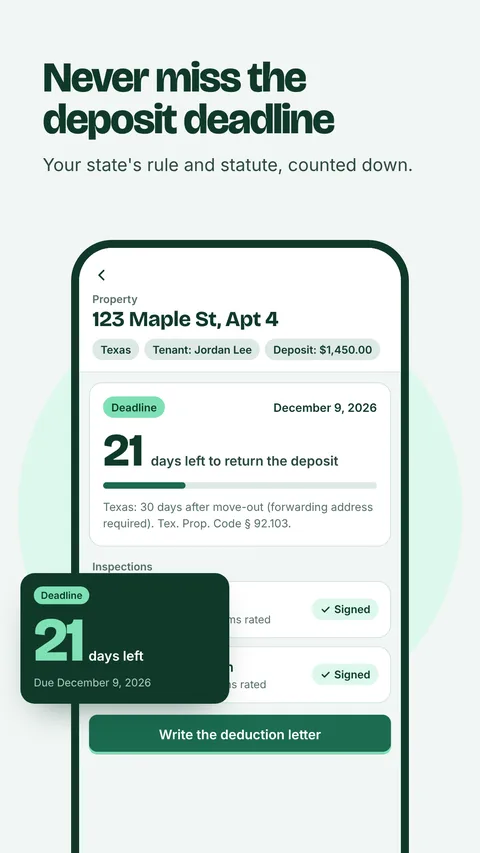
DepositDay walks you through every room, burns the date and time into each photo, and counts down your state's deadline so you know exactly when your landlord owes you. Free, no account.
Start a free move-out walkthrough
Common questions
Does a lease end when a tenant dies?
It depends on the state and the lease. In Virginia, a sole tenant's written lease is deemed terminated on the date of death if the tenant still lived there; in Texas, the estate's representative can end a sole occupant's lease by written notice; in Washington, a sole occupant's tenancy ends 15 days after the landlord's notice or on the paid-through date, whichever is later.
Who gets the security deposit when a tenant dies?
When the tenant lived alone, Texas sends the refund, less lawful deductions including the cost of removing and storing belongings, to the person the tenant designated or another person lawfully entitled to it. Washington sends it to the tenant representative with a full and specific statement of anything kept. Elsewhere, ask the landlord in writing and give a mailing address.
Who pays the rent when a tenant dies?
In Texas, the estate stays liable for unpaid rent and damage beyond normal wear and tear from before the lease ends, but ending the lease under the Texas rule avoids future rent. In Virginia, the estate is liable for the landlord's actual damages, which the landlord must mitigate. Both rules name the estate, not relatives, so check what you signed before paying from your own money.
What can a landlord do with a deceased tenant's belongings?
In Texas, a landlord can remove and store a sole occupant's belongings, but can discard them only if the designated person doesn't remove them by the 30th day after the postmark of a certified-mail request and no one claims them, unless the lease sets another procedure. Virginia requires at least 10 days' written notice when no one has a court order to handle probate, and Washington a second written notice and at least 45 days.
Can a landlord take back an apartment after a tenant dies?
In Virginia, a sole tenant's written lease is deemed terminated on the date of death if the tenant still lived there, and no court order of possession is needed. In Florida, at least 60 days after the last remaining tenant's death, the landlord can recover possession without court if belongings remain, rent is unpaid and no one has given written notice of a probate estate or personal representative, except in federally administered or regulated housing such as Section 8.
Related guides
General information, not legal advice. State and local rules differ and change. Read your state statute or ask a local attorney before you act. Deposit rules by state.