Penalty for late security deposit return, by state
Each row gives the state's return deadline, penalty, statute (linked to the official source) and the date we last checked it against that text; rows marked pending weren't re-read this cycle.
| State | Return deadline | Penalty | Statute | Last checked |
|---|---|---|---|---|
| Alabama | 60 days | 2x the deposit if refund or accounting is late | Ala. Code § 35-9A-201 | Nov 22, 2026 |
| Alaska | 14 days; 30 in some cases (e.g. damage deductions) | Up to 2x amount withheld, if willful | Alaska Stat. § 34.03.070 | Nov 22, 2026 |
| Arizona | 14 business days after move-out and the tenant's request | 2x amount wrongfully withheld | A.R.S. § 33-1321 | Nov 22, 2026 |
| Arkansas | 60 days | 2x amount wrongfully withheld, plus costs and fees | Ark. Code § 18-16-305 | Pending |
| California | 21 days. Since April 1, 2025, landlords must take photos after the tenant leaves (before repairs or cleaning) and again after the work, and send them with the itemized statement when deducting for repairs or cleaning. Receipts are required for deductions over $125. | Up to 2x deposit for bad faith, plus actual damages | Cal. Civ. Code § 1950.5 | Nov 22, 2026 |
| Colorado | 30 days (up to 60 if the lease says so). For tenancies ending in 2026 or later, photos, inspection reports, receipts or estimates supporting a deduction must be provided within 14 days of the tenant's written request. | 3x amount wrongfully withheld, plus fees | C.R.S. §§ 38-12-102.5, 38-12-103 | Nov 22, 2026 |
| Connecticut | 21 days, or 15 days after receiving a forwarding address, whichever is later | 2x the deposit | Conn. Gen. Stat. § 47a-21 | Nov 22, 2026 |
| Delaware | 20 days | 2x amount wrongfully withheld | 25 Del. C. § 5514 | Nov 22, 2026 |
| District of Columbia | 45 days to refund or give notice of withholding; balance within 30 days of that notice | Amount withheld; 3x for bad faith | D.C. Code § 42-3502.17; 14 DCMR §§ 308-311 | Nov 22, 2026 |
| Florida | 15 days if nothing is deducted; written notice of any claim within 30 days | Loses right to claim against the deposit, plus fees | Fla. Stat. § 83.49 | Nov 22, 2026 |
| Georgia | 30 days | Forfeiture; 3x plus fees unless a bona fide error | O.C.G.A. § 44-7-30 et seq. | Nov 22, 2026 |
| Hawaii | 14 days | Forfeiture; up to 3x for willful retention | Haw. Rev. Stat. § 521-44 | Nov 22, 2026 |
| Idaho | 21 days (up to 30 if the lease says so) | Up to 3x actual damages after notice | Idaho Code §§ 6-317, 6-320, 6-321 | Nov 22, 2026 |
| Illinois | 30 days to send the itemized statement; 45 days to return the deposit if no statement is sent. Chicago has its own ordinance with additional rules. | 2x the deposit, plus costs and fees | 765 ILCS 710/1 | Pending |
| Indiana | 45 days | Amount withheld plus attorney's fees | Ind. Code § 32-31-3-12 | Nov 22, 2026 |
| Iowa | 30 days after move-out and receipt of a forwarding address | Forfeiture; up to 2x monthly rent for bad faith | Iowa Code § 562A.12 | Nov 22, 2026 |
| Kansas | 14 days after deductions are determined; 30 days at most | Amount due plus 1.5x the amount wrongfully withheld | K.S.A. § 58-2550 | Nov 22, 2026 |
| Kentucky | No fixed return deadline. Where KRS 383.580 applies (cities and counties that adopted the uniform act), the landlord inspects, gives a signed damage list, and notifies the tenant of any refund. If the tenant doesn't respond within 60 days, the landlord may keep it. Signed move-in and move-out damage lists are required. | Forfeiture of the right to withhold | KRS 383.580 | Nov 22, 2026 |
| Louisiana | 1 month to return the deposit; since Aug 1, 2026 (Act 63 of 2026), the itemized statement of amounts kept may be sent up to 15 days after the one-month deadline | Amount withheld plus the greater of $300 or 2x, for willful failure | La. R.S. §§ 9:3251-9:3253 | Nov 22, 2026 |
| Maine | Up to 30 days under a written lease; 21 days for a tenancy at will | Forfeiture; 2x amount withheld | 14 M.R.S. §§ 6031-6034 | Nov 22, 2026 |
| Maryland | 45 days | Up to 3x amount withheld, plus fees | Md. Code, Real Prop. § 8-203 | Nov 22, 2026 |
| Massachusetts | 30 days | 3x the deposit owed, plus 5% interest and fees | M.G.L. c. 186, § 15B | Nov 22, 2026 |
| Michigan | 30 days to mail the notice of damages. Since Sept 21, 2026 (Public Act 102 of 2026), a landlord who pays the balance by direct deposit, bank transfer or a payment app instead of a check must deposit it within 10 days after mailing the notice | 2x amount retained | MCL §§ 554.601-554.616 | Nov 22, 2026 |
| Minnesota | 3 weeks after move-out and receipt of a forwarding address | 2x amount withheld, plus interest | Minn. Stat. § 504B.178 | Nov 22, 2026 |
| Mississippi | 45 days after move-out and the tenant's request | Up to $200 plus actual damages, for bad faith | Miss. Code § 89-8-21 | Nov 22, 2026 |
| Missouri | 30 days | 2x amount wrongfully withheld | Mo. Rev. Stat. § 535.300 | Nov 22, 2026 |
| Montana | 10 days if nothing is deducted; 30 days if there are deductions | Forfeiture of deductions; liable for amount withheld | Mont. Code §§ 70-25-202 to -204 | Nov 22, 2026 |
| Nebraska | 14 days | Costs and fees; willful failure adds the lesser of 1 month's rent or 2x the deposit | Neb. Rev. Stat. § 76-1416 | Nov 22, 2026 |
| Nevada | 30 days | Full deposit plus up to the deposit amount again | NRS 118A.242 | Nov 22, 2026 |
| New Hampshire | 30 days | 2x deposit plus interest, less lawful charges | RSA 540-A:5 to 540-A:8 | Nov 22, 2026 |
| New Jersey | 30 days | 2x amount owed, plus costs | N.J.S.A. § 46:8-19 et seq. | Nov 22, 2026 |
| New Mexico | 30 days | Forfeiture and fees; $250 civil penalty for bad faith | NMSA § 47-8-18 | Nov 22, 2026 |
| New York | 14 days after move-out | Forfeiture; up to 2x deposit if willful | N.Y. Gen. Oblig. Law § 7-108 | Nov 22, 2026 |
| North Carolina | 30 days (interim accounting if needed, final within 60) | Willful failure voids the right to keep any; damages and fees | N.C. Gen. Stat. §§ 42-50 to 42-56 | Nov 22, 2026 |
| North Dakota | 30 days | 3x money withheld without reasonable justification | N.D.C.C. § 47-16-07.1 | Nov 22, 2026 |
| Ohio | 30 days | Money due plus an equal amount, plus fees | Ohio Rev. Code § 5321.16 | Nov 22, 2026 |
| Oklahoma | 45 days after move-out and the tenant's written request | Tenant recovers the deposit; misappropriation can be a crime | 41 O.S. § 115 | Nov 22, 2026 |
| Oregon | 31 days | 2x amount withheld without an accounting or in bad faith | ORS 90.300 | Nov 22, 2026 |
| Pennsylvania | 30 days | Forfeiture; 2x amount wrongfully withheld | 68 P.S. §§ 250.511a-250.512 | Nov 22, 2026 |
| Rhode Island | 20 days | Amount due plus 2x amount wrongfully withheld, plus fees | R.I. Gen. Laws § 34-18-19 | Nov 22, 2026 |
| South Carolina | 30 days after the tenancy ends and possession is delivered, or after the tenant asks for it, whichever is later | 3x amount wrongfully withheld, plus fees | S.C. Code § 27-40-410 | Nov 22, 2026 |
| South Dakota | 21 days after the tenancy ends and the landlord receives the tenant's mailing address. An itemized accounting is due within 45 days if the tenant asks. | Forfeiture; up to $200 punitive damages for bad faith | SDCL § 43-32-24 | Nov 22, 2026 |
| Tennessee | No fixed return deadline. The statute applies only in counties over 75,000 population (2010 census). The landlord sends written notice of any refund; if the tenant doesn't respond within 60 days, the landlord may keep it. | Forfeiture if the deposit wasn't held in a separate account and documented as required | Tenn. Code § 66-28-301 | Nov 22, 2026 |
| Texas | 30 days after move-out (forwarding address required) | $100 plus 3x amount withheld and fees, for bad faith | Tex. Prop. Code § 92.103 | Nov 22, 2026 |
| Utah | 30 days | Full deposit plus a $100 civil penalty | Utah Code § 57-17-3 | Nov 22, 2026 |
| Vermont | 14 days | Forfeiture; 2x amount withheld if willful | 9 V.S.A. § 4461 | Nov 22, 2026 |
| Virginia | 45 days | Deposit plus actual damages and fees, if willful | Va. Code § 55.1-1226 | Nov 22, 2026 |
| Washington | 30 days after the rental agreement ends and the tenant vacates (since July 23, 2023). The statement must include documentation such as receipts or invoices. | Full deposit; a court may award up to 2x | RCW 59.18.280 | Nov 22, 2026 |
| West Virginia | 60 days, or 45 days after a new tenant moves in, whichever is sooner | Unreturned deposit plus 1.5x amount withheld, if willful | W. Va. Code § 37-6A-1 et seq. | Pending |
| Wisconsin | 21 days | 2x the tenant's loss, plus fees | Wis. Stat. § 704.28 | Nov 22, 2026 |
| Wyoming | 30 days, or 15 days after receiving a new address, whichever is later (30 more days if there's damage) | Full deposit plus court costs, if unreasonable | Wyo. Stat. § 1-21-1208 | Nov 22, 2026 |
The penalty column is a summary, so open the statute for the conditions. Many penalties depend on bad faith or willfulness, and a multiplier can apply to the whole deposit or only to the amount wrongfully withheld. Watch the start date too. Some deadlines depend on when you give a forwarding address or make a request. Your state's page in the DepositDay State Deposit Law Index has the full deadline rule. For how much a landlord can collect in the first place, see deposit limits by state.
Late isn't always bad faith: three kinds of rules
Before you add up a penalty, find out what triggers it. Some statutes attach a cost to the missed deadline itself. Others save the extra money for bad faith or willful conduct. A third kind treats a missed deadline as presumed bad faith. Here's how each works in the statutes we read in full for this page.
1. No bad faith needed
These rules attach a consequence to the missed deadline without asking why the landlord was late. In Massachusetts, a landlord that doesn't return the deposit or balance due, with any interest, within 30 days after the tenancy ends forfeits the right to keep any portion of it. The tenant "shall be awarded" damages equal to three times the deposit or balance due. On top of that come interest at 5% from the date payment became due, court costs and reasonable attorney's fees (Mass. Gen. Laws ch. 186, § 15B(6)(e), (7)). In New York, a landlord that doesn't provide the itemized statement and the deposit within 14 days after the tenant vacates forfeits any right to keep any portion (N.Y. Gen. Oblig. Law § 7-108(1-a)(e)).
Ohio's rule doesn't mention bad faith either. If the landlord misses its 30-day itemized notice, the tenant may recover the money due plus damages equal to the amount wrongfully withheld, and reasonable attorney's fees. Those damages and fees depend on the tenant having given a forwarding or new address in writing (Ohio Rev. Code § 5321.16(B)-(C)).
2. Bad faith or willfulness needed
Here the bigger penalty depends on how the landlord acted, not only when, and a court decides that. In Texas, a landlord that in bad faith keeps a deposit in violation of the deposit law is liable for $100, three times the portion wrongfully withheld, and the tenant's reasonable attorney's fees. A landlord that in bad faith doesn't provide a written description and itemized list of damages and charges forfeits the right to keep any of the deposit. It also loses the right to sue the tenant for damage to the unit and owes the tenant's reasonable attorney's fees (Tex. Prop. Code § 92.109(a)-(b)).
In New York, a landlord that violates the deposit rules is liable for actual damages. Punitive damages of up to twice the deposit apply only to one found to have violated them willfully (§ 7-108(1-a)(g)). Look for words like bad faith or willful in your state's row.
3. Late means presumed bad faith
Texas links the two. Its deadline is the 30th day after the tenant surrenders possession. A landlord that fails by then to return the deposit, or to provide a written description and itemization of deductions, is presumed to have acted in bad faith (§ 92.109(d)). Presumed isn't the same as proven. The court still decides whether there was bad faith. Separately, when a tenant sues, the landlord has the burden of proving that keeping any portion of the deposit was reasonable (§ 92.109(c)).
One state can use more than one kind. In New York, lateness alone forfeits the right to keep any portion, but punitive damages need a willful violation. Texas presumes bad faith after day 30, but its penalties still turn on bad faith.
Check when your clock started
A deadline only helps if you count from the right day. Here's what each statute above requires, and when its clock starts:
- Texas: the refund, by the 30th day after the tenant surrenders the premises, subject to the forwarding address rule below (Tex. Prop. Code § 92.103(a)).
- Ohio: the itemized notice with the amount due, within 30 days after the rental agreement ends and the tenant delivers possession (§ 5321.16(B)).
- Massachusetts: the deposit or balance due, with any interest, within 30 days after the tenancy ends (§ 15B(6)(e)).
- New York: the itemized statement and the rest of the deposit, within 14 days after the tenant vacates (§ 7-108(1-a)(e)).
Forwarding address rules can put off the landlord's duty or limit what you can recover. In Texas, the landlord isn't obligated to return the deposit or give a written description of damages and charges until you give a written forwarding address. You don't forfeit the refund merely for failing to give one (Tex. Prop. Code § 92.107). In Ohio, the tenant must give the landlord a forwarding or new address in writing, and a tenant who doesn't isn't entitled to the damages or attorney's fees in § 5321.16(C). Other states tie the deadline to your address too. The forwarding address guide lists them and shows how to send it with proof.
Write down the day you moved out and returned the keys, and the day the lease ended if that was different. Add the day you gave your forwarding address in writing. Then count. State pages in the index for states with a fixed deadline have a calculator that shows the date your deadline falls, counting from move-out. If the landlord got your address late, the deadline may not have passed yet. If you never gave one, send it now, in writing, and keep a copy.
A worked example: the refund arrives on day 40
Here is one hypothetical run through three statutes. The numbers show how each formula works. They aren't a prediction of what a court would award.
Hypothetical: $1,800 deposit, $600 kept, refund on day 40
Alex paid a $1,800 deposit. The lease ended the day Alex moved out, returned the keys and gave the landlord a forwarding address in writing. The landlord kept $600 for claimed damage and returned $1,200, but the check and the itemized list arrived on day 40 after move-out. In a second version, nothing ever arrives.
Texas
Deadline: day 30 after Alex surrendered the unit (§ 92.103(a)). Alex gave a written forwarding address, so § 92.107 doesn't put it off. Day 40 is late.
What's presumed: because the landlord missed day 30, it is presumed to have acted in bad faith (§ 92.109(d)). If Alex sues, the landlord has the burden of proving that keeping the $600 was reasonable (§ 92.109(c)), and the court decides whether there was bad faith.
If the court finds bad faith and that all $600 was wrongfully withheld: $100 + (3 × $600) = $1,900, plus Alex's reasonable attorney's fees (§ 92.109(a)).
If nothing ever arrives: the same presumption applies. If the court finds the landlord failed in bad faith to give the itemized list, it forfeits the right to withhold any part of the deposit. So the $600 is owed back along with the $1,200. It also can't sue Alex for damage to the unit, and it owes Alex's reasonable attorney's fees (§ 92.109(b)). If the court also finds the landlord kept the deposit in bad faith, § 92.109(a) applies to whatever portion it finds was wrongfully withheld.
Ohio
Deadline: the itemized notice, delivered with the amount due, within 30 days after the rental agreement ended and Alex delivered possession (§ 5321.16(B)). Day 40 misses it.
What Alex can recover: the money due, plus damages equal to the amount wrongfully withheld, plus reasonable attorney's fees (§ 5321.16(C)). If the court finds all $600 was wrongfully withheld: $600 due + $600 in damages = $1,200, plus fees. If it finds less was wrongfully withheld, the damages shrink to match.
The condition: Alex gave a forwarding address in writing. A tenant who doesn't isn't entitled to the damages or attorney's fees under § 5321.16(C). If nothing ever arrives, the same formula applies to whatever the court finds was wrongfully withheld.
Massachusetts
Deadline: the deposit or balance due, with any interest, within 30 days after the tenancy ended (§ 15B(6)(e)). Day 40 misses it, so the landlord forfeits the right to keep any portion, including the $600.
What Alex can recover: damages equal to three times the deposit or balance due, which the statute says the tenant "shall be awarded" (§ 15B(7)). Interest at 5% from the date payment became due, court costs and reasonable attorney's fees come on top. If the full $600 was due back: 3 × $600 = $1,800, plus interest, costs and fees.
Who decides the base: a court decides what amount was due, and so what gets tripled. If nothing ever arrives, the same rule applies to the amount the court finds was due.
For comparison: New York
The deadline is 14 days after the tenant vacates, so day 40 is far past it, and the landlord forfeits any right to keep any portion, including the $600 (§ 7-108(1-a)(e)). The landlord is liable for actual damages. Punitive damages of up to twice the deposit, at most 2 × $1,800 = $3,600, apply only if a court finds a willful violation (§ 7-108(1-a)(g)).
In each version, a court decides the facts each formula depends on. That includes bad faith or willfulness where the statute requires it, and how much was wrongfully withheld or due. A local legal aid office or a lawyer can run your own numbers against your state's statute.
How to claim the penalty, step by step
- Count the days. Find your deadline in the table and on your state page, and count from the right start date. Note the date anything arrived, and keep the envelope, postmark or email. If the deadline hasn't passed, wait.
- Read what you got. If a list arrived, check each charge against your photos. Charges for normal wear and tear are a common dispute. If nothing arrived, see what to do when a deposit isn't returned.
- Add up what you're owed. Start with the amount withheld, add any interest your state requires (deposit interest by state), then apply your statute's penalty formula. Check what it multiplies, since some statutes use the whole deposit and others only the amount wrongfully withheld.
- Send a written demand. Name the statute from the table, the deadline, the date the landlord missed it, the amount you're owed and the penalty the statute names. Set a date 10 to 14 days out and say you'll file in small claims if it isn't paid. Use the free demand letter, and send it by certified mail, or by email plus a text, so you can prove the date.
- File in small claims. If that date passes, file in the county where the rental is. Ask for the amount withheld plus the penalty, fees and costs your statute allows, and check that the total fits under your court's small claims limit. The small claims guide walks through filing and the hearing.
- Bring your evidence. The lease and proof you paid the deposit. Move-in and move-out photos. Proof of the day you moved out and returned the keys, and of when you gave your forwarding address in writing. The landlord's list and the envelope or email that shows when it came. Your demand letter and proof of sending. A one-page timeline with each date ties it together.
- Show the facts, not labels. If your state's penalty depends on bad faith or willfulness, walk the judge through what happened in order, starting with the deadline and the date it was missed. Then show what you asked for and how the landlord answered. In Texas, point to the presumption of bad faith after day 30 and the landlord's burden of proving that keeping any portion was reasonable (§ 92.109(c)-(d)). The court still decides.
For landlords: how to avoid a late-return penalty
This is general information, not legal advice. Your state's statute controls, and a local lawyer can check your process.
- Calendar the deadline the day the tenant leaves. Use the table for the number of days, and check what starts the clock in your state, such as move-out or the tenant's forwarding address. Leave time for mail.
- Ask for the forwarding address in writing at move-out, and keep proof of when you got it.
- Send the itemized list with the refund, on time. Give each deduction its own line and amount, and keep it to charges your state allows, such as unpaid rent and damage beyond normal wear and tear. The deduction letter template lays it out.
- Refund the undisputed amount by the deadline. If a repair bill isn't in yet, don't hold the whole deposit while you wait. Send what isn't in dispute on time, and ask a local lawyer how your state treats estimates.
- If you missed it, send the refund and the list now anyway. It won't erase the missed date. In some states lateness alone forfeits the right to keep deductions, so ask a lawyer whether to refund those too.
- Include any interest your state requires. In Massachusetts, the 30-day deadline covers the deposit or balance due with any interest.
- Keep proof of when you sent it. Certified mail or tracked delivery gives you a date. Keep copies of the list and the check or transfer record too.
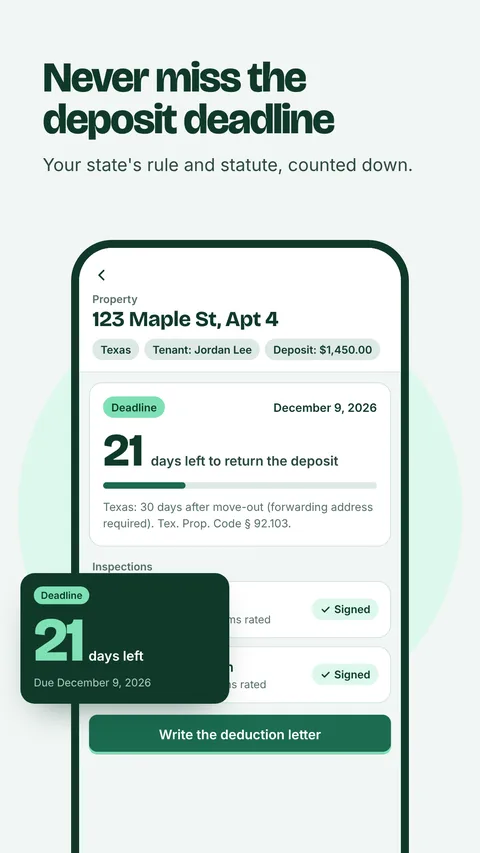
DepositDay walks you through every room, burns the date and time into each photo, and counts down your state's deadline so you know exactly when your landlord owes you. Free, no account.
Start a free move-out walkthrough
Common questions
What happens if a landlord doesn't return a security deposit within 30 days?
It depends on your state's deadline and penalty, which the table on this page lists. In Massachusetts, missing the 30-day deadline forfeits the landlord's right to keep any of the deposit. In Texas, it means the landlord is presumed to have acted in bad faith, though a court decides whether it did.
Can I sue my landlord for not returning my deposit on time?
Yes. You can file in small claims court for the amount withheld plus the penalty your state's statute allows, and the court decides what you're owed. Send a written demand citing the statute first, and bring proof of your move-out date, your forwarding address and anything the landlord sent.
Do I get double my deposit back if the landlord is late?
Not automatically. Penalties range from losing the right to keep any of the deposit, to fixed amounts, to two or three times the amount withheld, and many depend on a court finding bad faith or willfulness. In New York, for example, punitive damages of up to twice the deposit require a finding that the landlord willfully violated the law.
What is the penalty for returning a security deposit late in Texas?
A Texas landlord that misses the 30-day deadline is presumed to have acted in bad faith, and a court decides whether it did. A landlord that in bad faith keeps a deposit is liable for $100, three times the portion wrongfully withheld, and the tenant's reasonable attorney's fees.
Does a landlord lose the right to keep deductions if the deposit is late?
In some states. In Massachusetts, a landlord that doesn't return the deposit or balance due within 30 days after the tenancy ends forfeits the right to keep any portion. In New York, missing the 14-day deadline for the itemized statement and refund forfeits any right to keep any portion.
Does the deadline start if I never gave a forwarding address?
In some states, the landlord's duty waits for it. In Texas, the landlord isn't obligated to return the deposit or describe deductions until you give a written forwarding address. In Ohio, a tenant who never gives one in writing isn't entitled to the extra damages or attorney's fees.
Popular guides
General information, not legal advice. State and local rules differ and change. Read your state statute or ask a local attorney before you act. Deposit rules by state.