Trash or belongings: sort it first
Junk can be hauled away and charged for. Anything that may have value can fall under abandoned-property rules instead, covered in belongings left after move-out.
| Left behind | Usually | Removal charge |
|---|---|---|
| Bagged garbage, food, empty boxes | Trash | A reasonable cost |
| Broken furniture, a torn mattress, worn-out tires | Junk | A reasonable cost |
| Junk or piled-up yard waste outside | Trash | A reasonable cost (yard charges) |
| Usable furniture, electronics, tools, papers, photos | Belongings | Handled under the belongings rules |
| Closed boxes, full bins, anything unclear | Treat as belongings | Photograph it and set it aside |
If the landlord keeps, sells or reuses an item, it wasn't junk. Junk that was there at move-in shouldn't be on your bill. The move-in checklist settles it.
What a fair junk-removal charge looks like
A fair charge is the actual, reasonable cost, with proof for each part.
- A hauler's invoice showing the address, the date and the load.
- The dump fee, with the receipt. Mattresses and tires sometimes cost extra.
- The landlord's own labor at a reasonable hourly rate, for the hours spent. Four bags take minutes, not half a day.
- Dated photos, before and after.
A flat "trash-out fee" with no cost behind it is the easiest line to question. It generally holds up only if the lease sets it and state law allows it. Grime is a separate cleaning charge.
What state law says
Rules and deadlines vary by state (look up yours).
Florida: garbage is the tenant's job
Tenants must remove all garbage from the unit in a clean and sanitary manner (Fla. Stat. § 83.52(3)). The landlord has 15 days to return the deposit in full, or 30 days to send written notice of its intention to impose a claim and the reason, by certified mail or by email under § 83.505. If it misses the 30 days, it forfeits the right to impose a claim on the deposit, though it may still sue for damages after returning it (§ 83.49(3)(a)).
Arizona: the deposit can cover a broken trash duty
Tenants must dispose of all ashes, rubbish, garbage and other waste in a clean and safe manner (Ariz. Rev. Stat. § 33-1341(3)). Subject to the landlord's duty to mitigate, the deposit may be applied to charges in the signed lease and to damages from a tenant's failure to meet that duty. The itemized list of deductions is due within 14 days, excluding weekends and legal holidays, after the tenancy ends, you deliver possession and you ask for it (§ 33-1321(D)). If the landlord doesn't comply, you may recover the money due plus damages equal to twice the amount wrongfully withheld (§ 33-1321(E)).
Texas: the lease decides
The deposit can cover damages and charges you're legally liable for under the lease or as a result of breaching it, but not normal wear and tear. The landlord must return the rest with a written description and itemized list of all deductions. The list isn't required if you owed rent when you moved out and the rent amount isn't disputed (Tex. Prop. Code § 92.104). If your lease says to remove all trash and belongings, a reasonable hauling cost can fit.
Washington: proof goes with the statement
Tenants must properly dispose of all rubbish, garbage and other organic or flammable waste in a clean and sanitary manner (Wash. Rev. Code § 59.18.130(2)). Within 30 days after the lease ends and you move out, the landlord owes a full and specific statement of why it kept any of the deposit, with copies of estimates received or invoices paid to reasonably substantiate damage charges. If it does the work itself, it includes a copy of the bill, invoice or receipt for materials or supplies it deducts. Missing this makes the landlord liable for the full amount of the deposit (§ 59.18.280).
Massachusetts: not on the list
Deductions are limited to unpaid rent or water charges, certain real estate tax increases, and a reasonable amount to repair damage, excluding reasonable wear and tear. A damage deduction needs, within 30 days, a sworn itemized list with written evidence such as estimates, bills, invoices or receipts (Mass. Gen. Laws ch. 186, § 15B(4)). Junk removal isn't named. If it shows up, ask which category it falls under.
This is general information, not legal advice.
A worked example: itemized vs. flat fee
Hypothetical: a garage left full
Sam's deposit is $1,500. Sam leaves six trash bags, a broken dresser, a torn mattress, a working bike and a box of papers in the garage. The landlord photographs it all and sets the bike and papers aside.
Flat fee: "Trash-out fee, $500." Refund: $1,500 − $500 = $1,000.
Itemized:
Hauler invoice #1042, quarter-truck load: $175.00
Mattress fee, same invoice: $20.00
Landlord labor, 1.5 hours × $40: $60.00
Total: $255.00. Refund: $1,500 − $255 = $1,245.
No statute on this page sets a price.
Renters: avoid a junk charge or dispute one
- Empty the spots people forget: garage, shed, attic, patio, yard, storage cage.
- Book bulk pickup early. Don't leave bags beside a full dumpster.
- Photograph every room and storage space empty, with dates. The move-out cleaning checklist and move-out inspection checklist list the spots.
- If you're charged, compare the paperwork with your move-in record.
Then fill in and send this:
Re: Junk removal charge, [rental address]
You deducted $[amount] for junk removal. [My attached move-out photos show the [garage/yard/unit] empty.] [The [items] were there at move-in, as my move-in checklist shows.] [This is a flat fee, not a cost.] Please send the hauler's invoice or dump receipt, any labor hours and rate, and your photos. Please refund $[amount] by [date].
[Your name]
[Forwarding address]
If that doesn't settle it, see how to get your deposit back.
Landlords: make a junk charge hold up
- Record the garage, shed and yard at move-in on the move-in checklist.
- Photograph what's left before you touch it, and the empty space after.
- Sort it. Haul the trash. Set aside anything of possible value under the belongings rules.
- Bill the real cost: the hauler's invoice, the dump receipt and your own hours at a reasonable rate.
- Give it its own line on the itemized statement, sent by your state's deadline. The deduction letter template has room for it.
A line you can copy:
Junk removal, [date]: [items] from [garage/yard/unit], photos attached. Hauler invoice #[number]: $[amount]. Dump fee: $[amount]. Labor: [hours] hours × $[rate] = $[amount]. Total: $[amount].
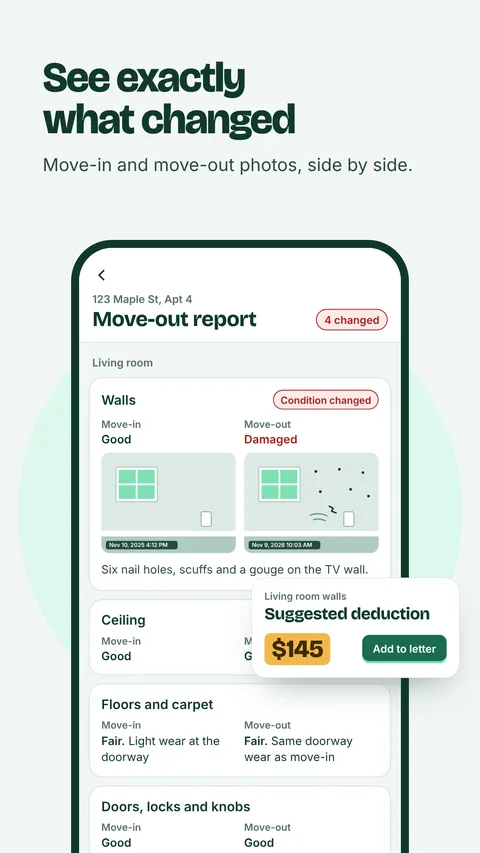
DepositDay walks you through move-in and move-out room by room, burns the date and time into every photo, shows what changed side by side, counts down your state's deadline, and writes the itemized deduction letter.
Start a free inspection
Common questions
Can a landlord charge for trash left after move out?
Generally yes, at a reasonable cost, and it can come out of the deposit where state law allows. The charge should be itemized and backed by an invoice, a receipt or a record of hours and rate.
Can a landlord deduct junk removal from a security deposit?
Usually, if it's a real, itemized cost. Arizona's deposit statute covers damages from a tenant's failure to dispose of rubbish and garbage, and Texas lets the deposit cover charges you're legally liable for under the lease. Massachusetts limits deductions to a short list that doesn't name junk removal.
How much can a landlord charge for junk removal?
None of the statutes on this page sets a price. A fair charge matches the actual cost, such as the hauler's invoice, the dump fee and the landlord's own time at a reasonable rate, with photos of what was removed.
Can a landlord charge a flat fee for trash removal?
A flat fee that isn't tied to an actual cost is the easiest charge to question. It generally holds up only if the lease sets it and state law allows it, so ask for the invoice or receipts behind it.
Can a landlord charge for their own labor to remove junk?
Generally yes, at a reasonable hourly rate for the hours actually spent, listed on the itemized statement. In Washington, a landlord who does the work must also include a copy of the bill, invoice or receipt for any materials or supplies it deducts, plus a statement of the time spent and the reasonable hourly rate charged.
Related guides
General information, not legal advice. State and local rules differ and change. Read your state statute or ask a local attorney before you act. Deposit rules by state.