Two questions decide it
A late fee on your itemized list should clear two tests. If it fails either one, that's the line to challenge.
- Was the late fee lawful? Your lease should set it, the rent should have been late enough under your state's rule, and the amount should be within any limit your state sets. New York and Texas set numbers. Massachusetts says no lease may impose interest or a penalty for late rent until it's 30 days overdue.
- Can the deposit cover it? Some states list what a deposit can be kept for, and the New York and Massachusetts lists leave late fees out. Texas and Arizona instead let the deposit cover charges owed under the lease.
A fee can pass one test and fail the other. In New York, a $50 fee on $2,000 rent paid a week late is within the late fee limit, but it still isn't a cost the landlord may keep from the deposit. In Texas, a late fee is the kind of lease charge a deposit can cover, but not if it breaks the state's late fee rule.
The four states side by side
| State | Can the deposit cover a late fee? | Limits on the late fee itself |
|---|---|---|
| New York § 7-108(1-a)(b) § 238-a(2) | Not on the list The deposit can be kept for unpaid rent, damage beyond normal wear and tear, unpaid utility charges payable to the landlord under the lease, and moving and storing your belongings | No fee unless rent isn't paid within five days of the due date. At most $50 or 5% of the monthly rent, whichever is less |
| Massachusetts ch. 186, § 15B(4) § 15B(1)(c) | Not on the list Deductions are limited to unpaid rent or water charges, certain real estate tax increases, and a reasonable amount to repair damage, excluding reasonable wear and tear | No lease may impose interest or a penalty for failure to pay rent until 30 days after it was due |
| Texas § 92.104 § 92.019 | If lawful The deposit can cover charges you're legally liable for under the lease | Must be in a written lease and reasonable, and rent must be unpaid two full days after the due date. Reasonable means up to 12% of the rent with four or fewer units, 10% with more than four, or more if not more than the landlord's uncertain damages related to the late payment |
| Arizona § 33-1321(D) | If in the lease The deposit can be applied to rent and, subject to the landlord's duty to mitigate, charges as specified in the signed lease or as provided in the chapter | Not covered on this page. Compare the fee with your signed lease |
HOA and condo fines raise the same question in a different form: the association usually bills the owner, and whether the fine can be passed on depends on the lease and the state's deposit rule. See can a landlord charge a tenant for HOA fines.
States that list what a deposit can cover
New York: late fees aren't on the list
Your deposit is refundable, except an amount lawfully kept for the reasonable, itemized costs of four things: unpaid rent, damage beyond normal wear and tear, unpaid utility charges payable directly to the landlord under the lease, and moving and storing your belongings (N.Y. Gen. Oblig. Law § 7-108(1-a)(b)). Late fees aren't one of the four. Unpaid rent is, so rent you still owe can come out of the deposit, but a late fee added to it can't.
New York also limits the fee itself. A landlord may not charge a late fee unless rent wasn't paid within five days of the date it was due, and the fee can't be more than $50 or 5% of the monthly rent, whichever is less (N.Y. Real Prop. Law § 238-a(2)). At $1,000 rent or more, that's $50. Below $1,000, 5% is lower: $40 on $800 rent. Some leases call late fees "additional rent." How that label is treated is a question for a local lawyer or legal aid office. Either way, check the fee against these limits. Deadlines and other rules: New York deposit law.
Massachusetts: three deductions and a 30-day wait
A Massachusetts landlord may deduct only three things from a deposit: unpaid rent or water charges that weren't validly withheld or deducted under law; unpaid real estate tax increases owed under a tax escalation clause that meets section 15C; and a reasonable amount to repair damage the tenant caused, excluding reasonable wear and tear (Mass. Gen. Laws ch. 186, § 15B(4)). Late fees aren't on the list.
The same statute limits when a lease can charge for late rent. No lease may impose any interest or penalty for failure to pay rent until 30 days after the rent was due (§ 15B(1)(c)). If your lease adds a fee after 5 or 10 days, point to that rule. Deadlines and other rules: Massachusetts deposit law.
States that let the deposit cover lease charges
Texas: a lawful late fee can come out
Before returning the deposit, a Texas landlord may deduct damages and charges you're legally liable for under the lease or as a result of breaking it. It may not keep any part of the deposit for normal wear and tear (Tex. Prop. Code § 92.104). A late fee in your lease can be one of those charges, but only if it follows the state's late fee rule.
Under that rule, a landlord may not collect a late fee unless three things are true: notice of the fee is in a written lease, the fee is reasonable, and rent has stayed unpaid two full days after the date it was originally due. A fee is reasonable if it's no more than 12% of the rent for the rental period in a building with four or fewer units, or 10% in a building with more than four. A higher fee is also reasonable if it's not more than the landlord's uncertain damages related to the late payment. A lease can set an initial fee plus a daily fee, but the two together count as a single late fee (Tex. Prop. Code § 92.019).
The rule comes with a penalty. A landlord who violates it is liable for $100, plus three times the late fee collected in violation, plus reasonable attorney's fees. A lease clause that waives the rule is void (§ 92.019). You can also ask the landlord for a written statement of whether you owe a late fee and how much. If the landlord doesn't answer, that doesn't cancel a fee you do owe (§ 92.0191). Ask before you move out, so a surprise fee doesn't first show up on the itemized list. Deadlines and other rules: Texas deposit law.
Arizona: charges in the signed lease
When the tenancy ends, an Arizona landlord may apply the deposit and any prepaid rent to all rent. Subject to its duty to mitigate, it may also apply them to all charges as specified in the signed lease agreement or as provided in the state's landlord-tenant chapter, including damages from the tenant's noncompliance with section 33-1341. The landlord must give you an itemized list of deductions within 14 days, not counting weekends and legal holidays, after the tenancy ends, you deliver possession and you ask for it (Ariz. Rev. Stat. § 33-1321(D)).
So a late fee spelled out in your signed lease is the kind of charge the deposit can be applied to. This page doesn't cover how large an Arizona late fee can be. If yours looks high, compare it with your lease and ask a local legal aid office. Ask for the itemized list in writing when you hand back the keys, because the 14 days count from the last of those three steps. Deadlines and other rules: Arizona deposit law.
Other states have their own rules (look up your state). This is general information. A local lawyer or legal aid office can apply it to your facts.
Worked examples
New York: $2,000 rent
Hypothetical: Dana rents an apartment in New York for $2,000 a month and paid a $2,000 deposit. Her lease sets a $100 late fee. She paid March rent on March 9, eight days after it was due on March 1.
Was a late fee allowed? Yes. Rent wasn't paid within five days of the due date.
How much? 5% of $2,000 is $100. The limit is the lesser of $50 or $100, so $50. The lease's $100 fee is $50 over the limit (§ 238-a(2)).
Can it come out of the deposit? No. Even the lawful $50 isn't one of the four costs New York lets a landlord keep from a deposit (§ 7-108(1-a)(b)).
The move-out statement: the landlord lists $300 for a door Dana broke and $100 for the March late fee, and refunds $1,600. The door charge fits the list as damage beyond normal wear and tear, if the cost is reasonable and itemized. The late fee doesn't. Dana writes back asking for the $100, which would bring her refund to $1,700.
Texas: $1,500 rent in a fourplex
Hypothetical: Luis rents one unit of a fourplex in Texas for $1,500 a month, with a $1,500 deposit. His written lease sets a $50 initial late fee plus $10 for each day rent stays unpaid. One month, the ledger shows the $50 fee and 16 daily fees.
Add the fees together. $50 + (16 × $10) = $210. Texas treats the initial and daily fees as one late fee.
Compare with the 12% figure. The building has four units, so the figure is 12% × $1,500 = $180. At $10 a day, the combined fee reaches $180 after 13 daily fees ($50 + $130). Luis's $210 is $30 over.
Ask about the rest. A fee over $180 is still reasonable if it's not more than the landlord's uncertain damages related to the late payment (§ 92.019). Luis asks the landlord in writing what the late payment cost it, and asks for the ledger showing when rent was due and when he paid.
If the fee checks out (it's in his written lease, it started only after rent had been unpaid two full days, and it's within the limit), it's a charge he's liable for under the lease. The landlord can then deduct it on the itemized list (§ 92.104).
Texas: the same rent in a 10-unit building
The building has more than four units, so the figure is 10% × $1,500 = $150. The combined fee reaches $150 after 10 daily fees ($50 + $100), and a $210 fee is $60 over. Same rent and same lease, but the figure is $30 lower because the building has more than four units.
Try your lease's formula in the late rent fee calculator, then compare the result with the limits above.
Late fee or unpaid rent? Read each line
In New York and Massachusetts, unpaid rent is on the list and late fees aren't, so the label on each line matters. In Texas and Arizona, unpaid rent and a lawful late fee can both come out, so check that each amount is right.
- Ask for the ledger. It should show each month's rent, the date you paid and every fee. Match each payment to your receipts or bank records.
- Look for fees inside "unpaid rent." If your payments were applied to old fees first, a fee can show up as unpaid rent on paper. Ask the landlord to split the line into rent and fees.
- Keep the two apart in your own math. Say you owe $2,000 for your last month in New York, plus a $50 late fee. The $2,000 is unpaid rent, which is on the list. The $50 isn't.
- Planning to let the deposit cover your last month? That leaves rent unpaid and can add a late fee on top. Read using your deposit as last month's rent first.
The same approach works for other charges. See unpaid utilities and the full list of what a landlord can deduct.
Check your deduction: a late fee checklist
Copy this list and fill it in for each late fee on the itemized list. Any "no" is worth raising with the landlord in writing.
Late fee deduction check
1. Late fee on the itemized list: $____ for [month].
2. My lease sets this fee: yes / no. Clause and page: ____. (Texas: notice of the fee must be in a written lease. Arizona: the deposit covers charges as specified in the signed lease or as provided in the chapter.)
3. Rent was late enough: yes / no. Due ____, paid ____. (New York: not paid within five days of the due date. Texas: unpaid two full days after the due date. Massachusetts: no interest or penalty until 30 days after the due date.)
4. The amount is within the limit: yes / no. (New York: $50 or 5% of monthly rent, whichever is less. Texas: 12% of the rent with four or fewer units or 10% with more than four, counting the initial and daily fees together, or more if not more than the landlord's uncertain damages related to the late payment.)
5. My state lets the deposit cover it: yes / no. (New York and Massachusetts: late fees aren't on the list. Texas: charges I'm legally liable for under the lease. Arizona: charges as specified in the signed lease or as provided in the chapter.)
6. The line shows the month, the due date, the date paid and the amount: yes / no.
7. I haven't already paid it: yes / no. Receipt or bank record: ____.
8. No late fee is hidden in the "unpaid rent" line: yes / no. Ledger requested on ____.
9. The itemized list arrived by my state's deadline: yes / no. Deadline: ____.
Amount to dispute: $____. Reason: ____.
Look up the deadline for item 9 on your state's page.
How to dispute a late fee deduction
Write to the landlord and name the line. Say which test it fails: the fee wasn't lawful, your state doesn't let the deposit cover it, or both. Attach the lease page, the itemized list and proof of when you paid. Ask for the money back by a date 10 to 14 days out, and send it in a way you can prove, such as certified mail, or email plus a text. Keep a copy. If the money doesn't come, see what to do when a landlord doesn't return your deposit.
Copy this and fill in the brackets. Keep the line for your state and delete the others.
[Date]
To: [Landlord or manager], [address or email]
Re: Late fee deducted from my security deposit, [rental address and unit]
Your itemized statement dated [date] deducts $[amount] from my security deposit as a late fee for [month]. I dispute this deduction.
[New York: Under N.Y. Gen. Oblig. Law § 7-108(1-a)(b), a landlord may keep deposit money only for the reasonable, itemized costs of unpaid rent, damage beyond normal wear and tear, unpaid utility charges payable directly to the landlord under the lease, and moving and storage of a tenant's belongings. Late fees are not on that list. N.Y. Real Prop. Law § 238-a(2) also limits a late fee to $50 or 5% of the monthly rent, whichever is less.]
[Massachusetts: Under Mass. Gen. Laws ch. 186, § 15B(4), a landlord may deduct only unpaid rent or water charges, certain real estate tax increases, and a reasonable amount to repair damage, excluding reasonable wear and tear. Late fees are not on that list.]
[Texas: This fee does not meet Tex. Prop. Code § 92.019 because [it is not in my written lease] [rent had not been unpaid for two full days after the due date] [the combined fee of $[amount] is more than [12% / 10%] of my monthly rent]. A landlord who violates § 92.019 is liable for $100, three times the late fee collected in violation, and reasonable attorney's fees. If you believe a higher fee is allowed because it is not more than your uncertain damages related to the late payment, please show me those costs.]
[Arizona: Ariz. Rev. Stat. § 33-1321(D) lets a deposit be applied to rent and to charges as specified in the signed lease agreement or as provided in the chapter. My signed lease does not specify this fee.]
[I paid this fee on [date]. Proof is attached.]
Please refund $[amount] by [date] to [forwarding address or payment method]. If you believe the fee is allowed, please send me the lease clause and the ledger showing the due date and the date I paid.
[Your name]
[Forwarding address]
[Phone and email]
Landlords: before you deduct a late fee
- Check your state's deduction rule. In New York and Massachusetts, late fees aren't on the list, so leave them off the deposit statement. Unpaid rent can still go on it.
- Check the fee itself. Confirm the lease sets it, rent was late enough under your state's rule, and the amount is within any limit. In Texas, add the initial and daily fees together before you compare the total with the 12% or 10% figure (§ 92.019).
- Give each late fee its own line with the month, the due date, the date paid and the amount. Keep it apart from unpaid rent and damage, and attach the ledger.
- Answer a Texas tenant who asks for a written statement of late fees owed (§ 92.0191). Settling the number before move-out heads off a dispute later.
- Send it on time. Check your state's deadline. In Arizona, the itemized list is due within 14 days, not counting weekends and legal holidays, after the tenancy ends, possession is delivered and the tenant asks for it (§ 33-1321(D)).
- Use a template so each line has what it needs: itemized deduction letter template.
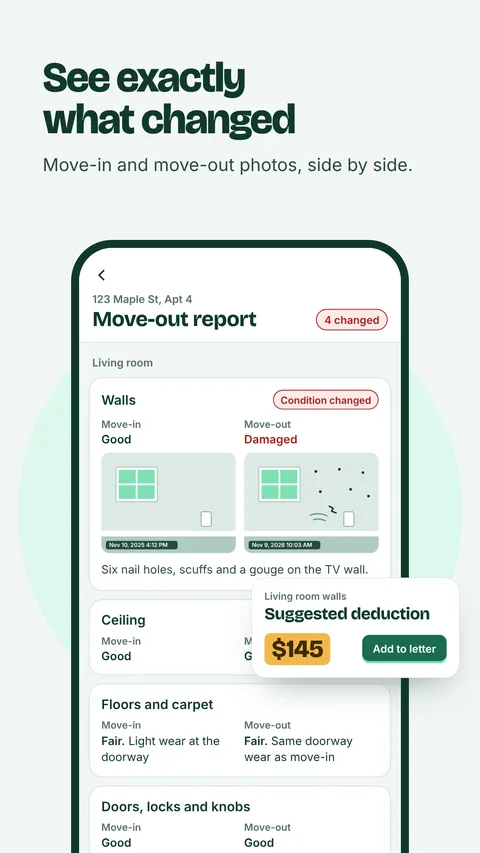
DepositDay walks you through move-in and move-out room by room, burns the date and time into every photo, shows what changed side by side, counts down your state's deadline, and writes the itemized deduction letter.
Start a free inspection
Common questions
Can a landlord deduct late fees from a security deposit?
It depends on the state. Texas and Arizona let the deposit cover charges owed under the lease, so a lawful late fee in the lease can come out. New York and Massachusetts limit deductions to a short list, and late fees aren't on it.
Can a New York landlord take a late fee out of my deposit?
Late fees aren't on the list of costs a New York landlord may keep from a deposit. The fee itself is also limited: none unless rent wasn't paid within five days of the due date, and no more than $50 or 5% of the monthly rent, whichever is less.
How much can a landlord charge for a late fee in Texas?
A late fee is reasonable if it's no more than 12% of the rent in a building with four or fewer units, or 10% in a building with more than four. A higher fee is also reasonable if it's not more than the landlord's uncertain damages related to the late payment. An initial fee and daily fees together count as one late fee.
When can a landlord charge a late fee in Massachusetts?
No lease may impose interest or a penalty for failure to pay rent until 30 days after the rent was due. Late fees also aren't among the three things a Massachusetts landlord may deduct from a deposit.
Can an Arizona landlord take unpaid late fees out of the deposit?
The deposit may be applied to rent and, subject to the landlord's duty to mitigate, to charges as specified in the signed lease or as provided in Arizona's landlord-tenant chapter. A late fee written into your signed lease is the kind of charge it can cover, as long as the fee itself is lawful.
How do I dispute a late fee taken from my deposit?
Write to the landlord, name the line, cite your state's rule and ask for the amount back by a set date. Attach your lease page, the itemized list and proof of when you paid, and keep proof that you sent it.
Related guides
General information, not legal advice. State and local rules differ and change. Read your state statute or ask a local attorney before you act. Deposit rules by state.