Light bulbs: wear vs. damage
A bulb has a limited life. When one burns out from normal use, it did what it was made to do. Charges come up when a bulb is gone, broken or wrong, or when a cover or fixture is damaged. Here is how common move-out findings usually sort out. The general rule is on wear and tear vs. damage.
| Found at move-out | Usually treated as | A fair charge |
|---|---|---|
| Bulb burned out from normal use | Wear and tear | Generally nothing. If the lease requires working bulbs at move-out, a similar bulb and a few minutes of work |
| Bulb missing, including original bulbs you swapped out and took with you | Chargeable | A similar bulb plus reasonable time to put it in |
| Bulb broken: shattered glass, or the base snapped off in the socket | Damage | A similar bulb plus the time to remove the broken base safely |
| Wrong type: wrong base or size, a non-dimmable bulb on a dimmer, or more wattage than the fixture's label allows | Chargeable | The right bulb plus a few minutes to swap it |
| Working bulb in a different brand or color than the others | Not damage | Hard to justify a charge |
| Dusty cover, or dead bugs inside a globe | Cleaning | Only cleaning beyond a normal turnover (see cleaning charges) |
| Cover yellowed or brittle from age and heat | Wear and tear | Generally nothing |
| Cover, globe or shade cracked, broken or missing | Damage | A similar cover, not a new fixture, unless the move-in report shows it was already damaged |
| Fixture that won't light even with a new bulb | Usually wear | Generally nothing, unless you damaged it |
| Fixture pulled loose, broken or removed | Damage | The reasonable cost to repair it or put back a similar one |
The move-in report decides many of these. If it says every light worked and every cover was intact, a missing bulb or a cracked globe at move-out stands out. If it doesn't mention the lights at all, both sides are guessing.
Who replaces light bulbs during the lease?
The lease usually answers this. Look for a clause about light bulbs, or about minor maintenance or tenant repairs. If the lease puts bulbs on you, replace them as they burn out and keep the receipts. If it's silent, ask the landlord in writing who handles bulbs, and save the reply.
Some bulbs aren't a quick swap. A high ceiling, a stairwell, an outdoor floodlight or a fixture that needs tools to open can take a tall ladder and some risk. Ask before you climb or take a fixture apart. If a light still won't work with a new bulb, the problem is likely the fixture, the switch or the wiring. Report it in writing with the date, so it isn't blamed on you at move-out.
Appliances have bulbs too: the oven, fridge, microwave and range hood often have their own. A burned-out appliance bulb is a small part that failed with use. See appliance damage for how the rest of the appliance is treated.
Burned-out bulbs at move-out
A bulb that burns out from normal use is ordinary wear. So the move-out question is narrower than whether any lights are out. A charge is generally reasonable only in four cases:
- Missing bulbs. A socket is empty, or you took bulbs that were there when you moved in.
- Broken bulbs. The glass is shattered, or the base snapped off in the socket.
- Wrong bulbs. The bulb doesn't fit, flickers on a dimmer, or goes over the fixture's wattage limit.
- A lease clause. Your lease says you must leave working bulbs in every fixture at move-out.
Read the exact words of the lease. A clause that says you replace bulbs during the tenancy is about upkeep while you live there. A clause that says every bulb must work when you move out is a move-out condition. With the second kind, a dead bulb at move-out is a lease issue, and the landlord has a stronger case for charging it. State law still matters, as the Texas and New York rules below show.
In every case, the charge should be the actual, reasonable cost: a similar bulb and the time it takes to put it in. It isn't a penalty, and it isn't a way to put new bulbs in the whole unit at your expense.
Renters: the cheapest fix is often to replace dead bulbs yourself before you leave. A few bulbs cost less than a dispute. It's on the move-out cleaning checklist too.
What a fair bulb charge looks like
A fair charge has two parts: the bulb and the labor.
- The bulb. Charge for a similar bulb. If the unit had basic LED bulbs, the charge is for basic LED bulbs, not smart bulbs or a pricier style. If the landlord buys multi-packs, the cost per bulb is the pack price divided by the count.
- The labor. Charge for the time the job takes, at a reasonable hourly rate. A standard bulb takes a minute or two. A high fixture, a cover held on with screws or a broken base stuck in a socket takes longer, and the charge can reflect that.
- One visit, one labor charge. If one visit covered several bulbs, the labor is for that visit, not repeated for every bulb.
- No flat fees out of line with the job. A flat fee per bulb that's far above the bulb plus a few minutes of work is worth questioning.
Bulbs are one line among many possible deductions. For the rest, see what a landlord can deduct from a deposit.
A worked example: a fair charge vs. a flat fee
Hypothetical. You move out of a two-bedroom apartment. The move-in report says every light worked. Your lease says nothing about bulbs at move-out. At the walk-through, the landlord finds three bulbs burned out (hallway, kitchen and bedroom closet), two empty sockets in the dining room fixture, and one bathroom bulb with its base snapped off in the socket. The landlord's maintenance worker fixes all of it on one visit.
The flat-fee version: 6 bulbs × $25 = $150.
A fair version:
Burned-out bulbs: $0. They burned out from use, and the lease doesn't require working bulbs at move-out.
Missing bulbs: 2 × $3.50 = $7.00 (basic LED bulbs, priced from the landlord's receipt for a multi-pack).
Broken bulb: 1 × $3.50 = $3.50.
Labor: 20 minutes to put in three bulbs and remove the broken base, at $45 an hour = $15.00.
Total: $25.50, not $150.
If the lease did require working bulbs at move-out, the three dead bulbs could be added: 3 × $3.50 = $10.50, plus 10 more minutes at $45 an hour = $7.50. The total would be $43.50, still under a third of the flat fee.
These prices are an example of a reasonable charge, not a legal limit. None of the statutes on this page sets a price for a bulb or an hour of labor. Use the real receipt and the real time.
Move-out bulb checklist
Copy this list and go room by room before the final walk-through.
Light bulbs and fixtures
- Turn on every light: ceiling lights, closets, hallways, stairs, the bathroom vanity, ceiling fans, and porch, garage and outdoor lights.
- Open the appliances and check the oven, fridge, microwave and range hood bulbs.
- Replace dead bulbs with a match: the same base and shape, the same color as the others in that fixture, and no more wattage than the fixture's label allows. Take the old bulb to the store, or photograph its label.
- Use dimmable bulbs on dimmer switches.
- Put the original bulbs back if you swapped in your own smart or specialty bulbs and want to keep yours.
- Remove a broken bulb safely. Turn off the power at the switch or breaker first, and wear gloves. If the base won't come out, leave it and tell the landlord in writing.
- Check covers, globes and shades for cracks or missing pieces, and compare them with your move-in photos.
- Clean the covers. Dust them and empty out dead bugs.
- Write down any light that won't work with a new bulb, and tell the landlord in writing before you leave.
- Keep the receipt for every bulb you buy.
- Photograph or video each room with the lights on, and record it on your move-out inspection checklist.
What state law says
None of the four statutes below mentions light bulbs. The wear-and-tear rule, the reasonable-cost rule and the paperwork rules decide it. Here is how four states put them:
Texas
A landlord may deduct damages and charges you're legally liable for under the lease or as a result of breaching the lease. A landlord may not keep any portion of the deposit to cover normal wear and tear (Tex. Prop. Code § 92.104). For bulbs, that makes the lease the first thing to read. If it requires working bulbs at move-out, the landlord will point to that clause. For a bulb that simply burned out, you can point to the wear-and-tear rule.
New York
A landlord may keep the deposit only for reasonable and itemized costs due to non-payment of rent, damage beyond normal wear and tear, non-payment of utility charges payable directly to the landlord under the lease, and moving and storage of your belongings. Nothing may be kept for ordinary wear and tear or for damage a prior tenant caused (N.Y. Gen. Oblig. Law § 7-108(1-a)(b)). For a bulb, the only reason on that list that could fit is damage beyond normal wear and tear, and the cost has to be reasonable and itemized. If your move-in report shows a socket was already empty or a cover already cracked, point that out.
Massachusetts
Repair deductions are limited to a reasonable amount necessary to repair damage caused by you, or by people under your control or on the premises with your consent, with reasonable wear and tear excluded. Within 30 days, the landlord must give you an itemized list of damages, sworn under pains and penalties of perjury, with written evidence such as estimates, bills, invoices or receipts showing the actual or estimated cost (Mass. Gen. Laws ch. 186, § 15B(4)). So a deduction for a broken bulb or a cracked globe, even a few dollars, should come with that sworn list and written evidence of the cost. Details: Massachusetts deposit law.
Washington
No portion of the deposit may be withheld for wear resulting from ordinary use. With the statement, the landlord must include copies of estimates or invoices paid. When the landlord or the landlord's employee does the repair and deducts for materials or supplies, the landlord must provide a copy of the bill, invoice or receipt. For supplies already on hand, a vendor price list or other vendor document can show the cost. The landlord must also include a statement of the time spent and the reasonable hourly rate (Wash. Rev. Code § 59.18.280(1)(b)-(c)). That fits bulbs closely. In the example above, it means the bulb receipt or a vendor price list, plus a statement of the 20 minutes and the $45 rate. Details: Washington deposit law.
Other states have their own rules. Look up your state.
Renters: disputing a bulb charge
Start with the paperwork. Ask for the receipt or invoice for the bulbs, the time and hourly rate for any labor, and the move-out photos. Compare them with your move-in report and photos.
- Burned out, and the lease is silent? Say in writing that the bulbs burned out from normal use and your lease doesn't require working bulbs at move-out.
- A flat fee? Offer the actual cost of similar bulbs plus a few minutes of labor, and ask for the rest back.
- Already missing or cracked at move-in? Send the move-in report or photo that shows it.
- A light that never worked? Send a copy of your written repair request, if you made one.
Copy this message and fill in the brackets:
Re: Light bulb charge, [rental address]
Your deduction list charges $[amount] for [number] light bulbs. [The bulbs burned out from normal use, and my lease does not require working bulbs at move-out.] [My move-in report shows these sockets were already empty.] Please send the receipt or invoice for the bulbs and the time and hourly rate for any labor.
I'm willing to pay $[amount], the cost of [number] similar bulbs plus reasonable labor. Please refund the remaining $[amount] by [date].
[Your name]
[Forwarding address]
[Phone and email]
Keep a copy and proof of when you sent it. If that doesn't settle it, see how to get your deposit back.
Landlords: bulbs at turnover
- Record the lights at move-in. Note on the move-in report that every fixture works, the bulb type, and any cracked or missing covers. Photograph the fixtures with the lights on.
- Treat burned-out bulbs as upkeep unless your lease clearly requires working bulbs at move-out.
- Charge for missing, broken or wrong bulbs at the real cost of a similar bulb plus the time spent.
- Keep the paper. Save the receipt, or a vendor price list for bulbs from stock, and log the minutes and the hourly rate. Washington and Massachusetts spell out the documentation they require (above).
- List each item by room and fixture on the itemized statement. The deduction letter template has a line for each.
- Keep it small and documented. A charge of a few dollars that you can show is easier to defend than a flat fee you can't.
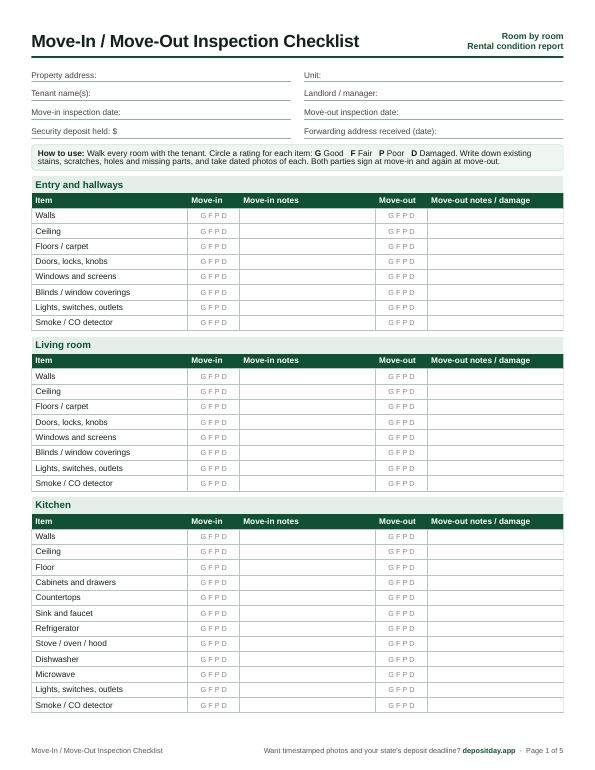
Room-by-room condition report: 12 rooms, 99 items, move-in and move-out columns, signature lines, and tips that win deposit disputes. Fill it in at move-in so the move-out comparison is easy. PDF, 5 pages, no sign-up.
Download the free PDF
Before anyone deducts
Every state sets a deadline for returning the deposit or sending an itemized list of deductions, from 14 to 60 days. Missing it can cost the landlord the right to keep anything. Look up your state. Landlords: use the free deduction letter template. Renters: see how to get your deposit back.
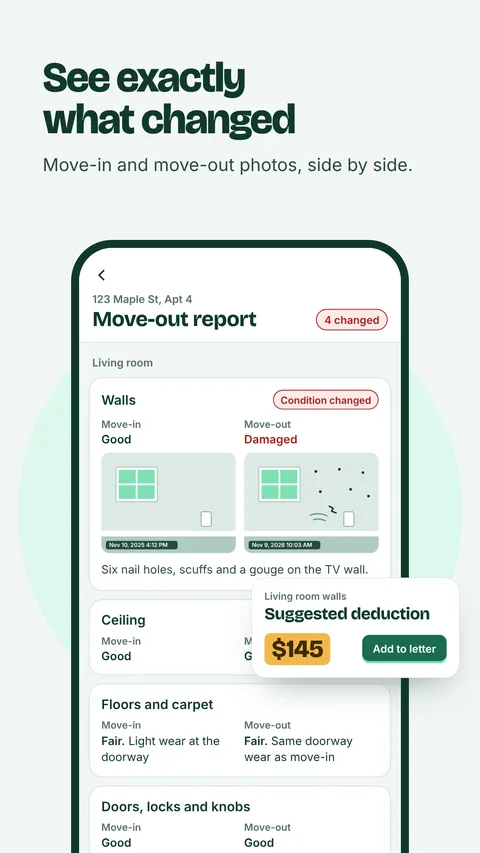
DepositDay walks you through move-in and move-out room by room, burns the date and time into every photo, shows what changed side by side, counts down your state's deadline, and writes the itemized deduction letter.
Start a free inspection
Common questions
Can a landlord charge for burned out light bulbs?
Usually not when they simply burned out from normal use, because that's ordinary wear. If your lease requires working bulbs at move-out, a charge is easier to justify, but it should still be the real cost of similar bulbs plus a few minutes of work.
Can a landlord charge for missing light bulbs?
Generally yes, at the cost of a similar bulb plus reasonable time to put it in. If the move-in report shows the socket was already empty, point that out.
Who is responsible for replacing light bulbs in a rental?
It usually comes from the lease, so look for a clause on bulbs or minor maintenance. If the lease is silent, ask the landlord in writing, and report any light that won't work with a new bulb.
How much can a landlord charge for a light bulb?
None of the statutes on this page sets a price per bulb. A fair charge is the actual cost of a similar bulb plus reasonable labor, so a flat fee like $25 a bulb is worth questioning. Ask for the receipt.
Can a landlord charge for a broken light fixture cover?
Generally yes, if you broke it and the move-in report shows it was intact. Yellowing or brittleness from age and heat is wear. The fair charge is a similar cover plus installation, not a whole new fixture.
Do I have to replace light bulbs before moving out?
Check your lease, since some leases require working bulbs at move-out. Even if yours doesn't, replacing a few bulbs is usually cheaper than disputing a charge. Keep the receipt and photograph each room with the lights on.
Related guides
General information, not legal advice. State and local rules differ and change. Read your state statute or ask a local attorney before you act. Deposit rules by state.