Three questions decide it
An HOA fine on a rental usually moves in up to three steps: the association levies it, the landlord bills the tenant, and the landlord may take it from the deposit. A charge that fails the test at any step is the one to question.
- Who did the association fine? An HOA's rules generally bind the owner, and the association usually sends the violation notice and the bill to the owner. In Florida, the HOA and condo statutes also name tenants among the people an association can fine, and the notice goes to the tenant it seeks to fine as well as to the owner.
- Does the lease pass it on? Look for an HOA-rules clause. It usually says you received the association's rules, that you and your household and guests will follow them, and that you're responsible for fines caused by your household or guests. If your lease has nothing like that, ask the landlord which clause it's relying on.
- Can it come out of the deposit? The state's deposit statute decides that, not the HOA. Texas and Arizona let the deposit cover charges under the lease. New York and Massachusetts list what a deposit can be kept for, and a fine isn't on the list.
A fine can pass one test and fail another. In New York, an HOA-rules clause still doesn't put a fine on the list of four costs a landlord may keep from a deposit. In Texas, a fine your lease makes you liable for can come out of the deposit, but the association must first give the owner written notice by certified mail, so a fine levied without it is worth questioning. The same two-part check works for late fees taken from a deposit.
State rules side by side
Two kinds of law matter: the rules for how an association levies a fine, and the deposit statute that sets what a landlord may keep. "Not covered" means this page doesn't address that question for that state. It doesn't mean the answer is no.
| State | Can the HOA fine the tenant directly? | Notice before a fine | Can it come out of the deposit? |
|---|---|---|---|
| Florida (HOA) § 720.305(2) § 83.49(3)(a) | The statute names tenants. Its $100-per-violation limit covers fines against any member or any member's tenant, guest or invitee, unless the governing documents provide otherwise | At least 14 days' written notice of the right to a hearing, to the owner and, if applicable, any occupant sought to be fined. A committee of at least three must approve the fine by majority vote | Not covered on this page. Deadline: 15 days to return it in full, or 30 days to send written notice of a claim (by certified mail or, under § 83.505, email) |
| Florida (condo) § 718.303(3) § 83.49(3)(a) | The statute names tenants. It covers a failure of the unit owner or its occupant, licensee or invitee to comply | At least 14 days' written notice to the owner and, if applicable, any tenant sought to be fined, and an opportunity for a hearing before a committee of at least three, which must approve the fine by majority vote | Not covered on this page. Same deadline as the row above |
| Texas § 209.006 § 92.104 | The statute speaks of notice to the owner | Written notice to the owner by certified mail. It must say the owner is entitled to a reasonable period to cure a curable violation that isn't a threat to public health or safety, and may request a hearing on or before the 30th day after mailing. If the owner cures before the cure period expires, no fine may be assessed. Doesn't apply to a violation already noticed in the past six months | If the lease makes the tenant liable for it Charges the tenant is legally liable for under the lease or as a result of breaching it |
| Arizona § 33-1803 § 33-1806.01 § 33-1321(D) | The statute speaks of penalties on members. A rental can't be fined any differently than an owner-occupied property | Notice and an opportunity to be heard. The member may respond by certified mail within 21 calendar days, and the association must answer within 10 business days | If the lease makes the tenant liable for it Charges as specified in the signed lease, subject to the landlord's duty to mitigate |
| New York § 7-108(1-a)(b) | Not covered on this page | Not covered on this page | Not on the statute's list The list: unpaid rent, damage caused by the tenant beyond normal wear and tear, unpaid utility charges payable directly to the landlord under the lease, and moving and storing the tenant's belongings |
| Massachusetts ch. 186, § 15B(4) | Not covered on this page | Not covered on this page | Not on the statute's list The list: unpaid rent or water charges, certain real estate tax increases, and a reasonable amount to repair damage, excluding reasonable wear and tear |
Wherever you rent, ask for the association's notices and its rules on fines. Deadlines and other deposit rules: look up your state.
What each state's statute says
Florida HOAs: tenants can be fined, after notice and a committee vote
A Florida homeowners' association may levy reasonable fines for violations of the declaration, the bylaws or reasonable rules. A fine may not exceed $100 per violation against any member or any member's tenant, guest or invitee, unless the governing documents provide otherwise. A fine may be levied for each day of a continuing violation, with a single notice and opportunity for hearing, but it may not exceed $1,000 in the aggregate unless the governing documents provide otherwise. A fine of less than $1,000 may not become a lien against a parcel (Fla. Stat. § 720.305(2)).
The board must first give at least 14 days' written notice of the parcel owner's right to a hearing, to the owner and, if applicable, to any occupant, licensee or invitee it seeks to fine. The hearing is held within 90 days of the notice, before a committee of at least three members who aren't officers, directors or employees, or their close relatives. If the committee doesn't approve a proposed fine by majority vote, it may not be imposed (§ 720.305(2)(b)-(c)). If the association seeks to fine you, that notice must go to you as well as to the owner. Show it to your landlord right away.
Florida condos: $100 per violation, $1,000 in the aggregate
A Florida condo association may levy reasonable fines for a failure of the unit owner or its occupant, licensee or invitee to comply. A fine may not exceed $100 per violation or $1,000 in the aggregate, and it may not become a lien against a unit. Notice and the committee vote work as in the table above. If the committee approves a fine, payment is due 5 days after notice of the approved fine is provided to the owner and, if applicable, the tenant (Fla. Stat. § 718.303(3)).
On the deposit side, this page doesn't cover which charges Florida lets a landlord claim. It covers the timing: a Florida landlord has 15 days to return the deposit in full, or 30 days to send written notice of its intention to impose a claim on it, by certified mail to your last known mailing address or by email under § 83.505 (Fla. Stat. § 83.49(3)(a)). Deadlines and other rules: Florida deposit law.
Texas: certified mail to the owner, a cure period and a hearing
Before a Texas property owners' association may levy a fine for a violation of the restrictions, bylaws or rules, it must send the owner written notice by certified mail. The notice must describe the violation and state any amount due. It must tell the owner that the owner is entitled to a reasonable period to cure the violation and avoid the fine, if the violation is curable and isn't a threat to public health or safety, and that the owner may request a hearing under section 209.007 on or before the 30th day after the notice was mailed. If the owner cures the violation before the cure period expires, a fine may not be assessed. These notice steps don't apply to a violation the owner was already given notice of under this section in the preceding six months (Tex. Prop. Code § 209.006).
The statute gives examples. Curable: a parking violation, a maintenance violation, or an ongoing noise violation such as a barking dog. Uncurable: shooting fireworks, a noise violation that isn't ongoing, property damage, and holding a garage sale or other event prohibited by a dedicatory instrument. Because the notice goes to the owner, a renter usually learns of a violation only when the landlord passes it on. If the cure period ran out before you saw the notice, ask the landlord when it arrived and when it was sent to you.
For the deposit, a Texas landlord may deduct damages and charges you're legally liable for under the lease or as a result of breaching it, may not keep any part for normal wear and tear, and must give you a written description and itemized list of deductions, unless you owe rent at move-out and the amount isn't disputed (Tex. Prop. Code § 92.104). A fine your lease makes you responsible for can fit. One the lease doesn't cover, or one levied without the required notice, is the line to question. Deadlines and other rules: Texas deposit law.
Arizona: penalties on members, and no different fines for rentals
After notice and an opportunity to be heard, an Arizona association's board of directors may impose reasonable monetary penalties on members for violations of the declaration, bylaws and rules (Ariz. Rev. Stat. § 33-1803(B)). A member who receives written notice of a violation may respond by certified mail within 21 calendar days. The association must then answer within 10 business days with the provision violated, the date of the violation or when it was observed, the name of the person or people who observed it, and the process to contest it (§ 33-1803(C)-(D)). The statute gives that right to the member, so if you dispute a violation, ask your landlord to respond within the 21 days.
Two rules protect rentals. Except for the tenant-disclosure fee and recreational-facility fees, an association may not assess, levy or charge a fee or fine, or otherwise impose a requirement, on a member's rental property any differently than on an owner-occupied property (Ariz. Rev. Stat. § 33-1806.01(D)). It also may not require a tenant to sign a waiver or other document limiting the tenant's due process rights as a condition of occupancy (§ 33-1806.01(E)(2)).
For the deposit, an Arizona landlord may apply it when the tenancy ends to all rent and, subject to its duty to mitigate, all charges as specified in the signed lease agreement. The itemized list is due within 14 days, not counting weekends and legal holidays, after the tenancy ends, you deliver possession and you ask for it (Ariz. Rev. Stat. § 33-1321(D)). An HOA fine your signed lease makes you responsible for is the kind of charge the deposit can be applied to. Deadlines and other rules: Arizona deposit law.
New York: a fine isn't on the deposit list
A New York landlord may keep deposit money only for the reasonable, itemized costs of four things: unpaid rent, damage caused by the tenant beyond normal wear and tear, unpaid utility charges payable directly to the landlord under the lease, and moving and storing the tenant's belongings (N.Y. Gen. Oblig. Law § 7-108(1-a)(b)). An HOA or condo fine isn't one of the four, even if your lease makes you responsible for HOA fines. Whether a landlord can pursue the fine some other way is a question for a local lawyer or legal aid office. If the violation also damaged the rental, the reasonable, itemized cost of damage the tenant caused beyond normal wear and tear is on the list, even though the fine isn't. Deadlines and other rules: New York deposit law.
Massachusetts: three deductions, and a fine isn't one
A Massachusetts landlord may deduct only three things from a deposit: unpaid rent or water charges not validly withheld, unpaid real estate tax increases under a conforming tax escalation clause, and a reasonable amount to repair damage caused by the tenant or by people under the tenant's control or on the premises with consent, excluding reasonable wear and tear. For damage, the landlord must give a sworn itemized list with written evidence of the cost within 30 days (Mass. Gen. Laws ch. 186, § 15B(4)). A fine isn't on the list. If the violation also damaged the rental, the reasonable repair cost could be a damage deduction with that sworn list, but the fine itself still isn't. Deadlines and other rules: Massachusetts deposit law.
For a state not covered here, start with your state's deposit rules. This is general information. A local lawyer or legal aid office can apply it to your facts.
Worked examples
Texas: two fines, one to dispute
Hypothetical: Jordan rents a house in a Texas HOA neighborhood for $1,800 a month and paid an $1,800 deposit. The lease has an HOA-rules clause: Jordan received the rules and is responsible for HOA fines caused by Jordan's household or guests.
July: fireworks. Jordan's guests set off fireworks in the street. The statute calls shooting fireworks uncurable, so there's no cure period. The association's certified-mail notice to the owner describes the violation, says a $300 fine will be levied and says the owner may request a hearing on or before the 30th day after mailing. The landlord forwards it, Jordan agrees the guests did it, and nobody asks for a hearing.
September: parking. The association sends the owner notice of a parking violation, Jordan's car left on the street overnight against the rules, with a cure period ending September 20. The landlord forwards it the day it arrives, and the car is off the street by September 12. The association bills a $100 fine anyway.
The move-out statement: the landlord deducts both fines, $300 + $100 = $400, and refunds $1,800 − $400 = $1,400.
Checking it: the fireworks fine came with the notice the statute requires, it's for something Jordan's guests did during the lease, and the lease makes Jordan responsible for it. That makes it a charge Jordan is liable for under the lease, which the deposit can cover (§ 92.104). The parking fine is the one to question. If the owner cures the violation before the cure period expires, a fine may not be assessed. These notice steps don't apply to a violation the owner was already given notice of under this section in the preceding six months (§ 209.006(e)). Jordan sends the landlord the dates and asks for the $100, which would bring the refund to $1,800 − $300 = $1,500.
Florida: a daily fine over the limit
Hypothetical: Priya rents a house in a Florida HOA community, and her lease makes her responsible for HOA fines caused by her household or guests. A visiting relative leaves a camper in the driveway for 14 days, against the HOA's rules. The board gives the owner written notice of the right to a hearing 16 days before the hearing, the three-member committee approves a fine of $100 a day, and the association bills the owner. The landlord passes the bill to Priya.
The bill: 14 days × $100 = $1,400.
The limit: a fine for a continuing violation may not exceed $1,000 in the aggregate unless the governing documents provide otherwise (§ 720.305(2)). If this community's documents don't allow more, $1,400 − $1,000 = $400 of the bill is over the limit.
What Priya asks for: the notice, the committee's decision and the part of the governing documents that covers fines. If the documents allow a higher total, the full bill may stand. If they don't, she offers $1,000 and disputes the $400.
If it goes on the deposit statement: this page doesn't cover which charges Florida lets a landlord claim against a deposit. A landlord that intends to impose a claim on it has 30 days to send written notice, by certified mail or by email under § 83.505 (§ 83.49(3)(a)).
Renters: check an HOA fine before you pay it
An HOA fine usually reaches a renter secondhand, as a bill from the landlord or a line on the deposit statement. Ask for the paperwork behind it first.
- Get the HOA's violation notice and fine notice. A landlord passing on a fine should be able to show what the association sent, when and to whom. A bill with nothing behind it is the first thing to question.
- Check the date. The violation should fall between your move-in and move-out dates. If it doesn't, say so in writing.
- Check who caused it. An HOA-rules clause usually covers you, your household and your guests. Who handles yard care and exterior upkeep usually comes from the lease, so a fine about the roof, the fence or the paint may stay with the landlord. For lawn and yard charges, see yard damage.
- Check the HOA's steps and the amount against the table and state notes above. In Florida, that means the 14-day notice, the committee vote and the $100 and $1,000 limits.
- Check the lease clause the landlord relies on, word for word.
- Check your move-in record. If the problem was there when you moved in, your move-in checklist and photos can show it.
How to dispute an HOA fine charged to you
Write to the landlord, name the charge and say why you dispute it. Attach the lease page, the bill or itemized list, and anything that shows dates, such as photos or texts. Ask for the money back by a set date, send the letter in a way you can prove, and keep a copy. If that doesn't settle it, see how to get your deposit back and how to sue a landlord for a security deposit.
Copy this and fill in the brackets. Keep the lines that fit and delete the others.
[Date]
To: [Landlord or manager], [address or email]
Re: HOA fine charged to me, [rental address and unit]
You [billed me / deducted from my security deposit] $[amount] for a fine from [association name] for [violation] on [date]. I dispute this charge.
Please send me copies of:
1. The association's violation notice and fine notice, showing when each was sent and to whom.
2. Any hearing notice and the decision approving the fine.
3. The lease clause you are relying on.
[The violation is dated [date], which is [before my lease began on [date]] [after I moved out on [date]].]
[The violation was not caused by me, my household or my guests. [Brief explanation.]]
[My lease does not make me responsible for association fines.]
[The violation was cured on [date], before the cure period in the notice expired.]
[I did not receive the notice until [date], after the [cure period / hearing deadline] had passed.]
[Florida HOA: Under Fla. Stat. § 720.305(2), a fine requires at least 14 days' written notice of the right to a hearing and the committee's approval by majority vote. Unless the governing documents provide otherwise, it may not exceed $100 per violation, or $1,000 in the aggregate for a continuing violation.]
[Florida condo: Under Fla. Stat. § 718.303(3), a fine requires at least 14 days' written notice, an opportunity for a hearing and the committee's approval by majority vote, and it may not exceed $100 per violation or $1,000 in the aggregate.]
[Texas: Tex. Prop. Code § 209.006 requires the association to give the owner written notice by certified mail before levying a fine, and if the owner cures the violation before the cure period expires, a fine may not be assessed. Tex. Prop. Code § 92.104 lets a landlord deduct charges I am legally liable for under the lease, and [my lease does not make me liable for this fine] [this fine should not have been assessed].]
[Arizona: [The association fined this rental differently than it fines owner-occupied property, which Ariz. Rev. Stat. § 33-1806.01(D) does not allow.] [Ariz. Rev. Stat. § 33-1321(D) lets a deposit be applied to charges as specified in the signed lease agreement, and my signed lease does not specify this charge.]]
[New York: N.Y. Gen. Oblig. Law § 7-108(1-a)(b) lets a landlord keep deposit money only for the reasonable, itemized costs of unpaid rent, damage I caused beyond normal wear and tear, unpaid utility charges payable directly to the landlord under the lease, and moving and storage of my belongings. An association fine is not on that list.]
[Massachusetts: Under Mass. Gen. Laws ch. 186, § 15B(4), a landlord may deduct only unpaid rent or water charges, certain real estate tax increases, and a reasonable amount to repair damage, excluding reasonable wear and tear. An association fine is not on that list.]
Please refund $[amount] by [date] to [forwarding address or payment method]. If you believe the charge is allowed, please send me the documents listed above.
[Your name]
[Forwarding address]
[Phone and email]
Landlords: HOA fine pass-through checklist
The association usually bills you, the owner. These steps make a fine easier to pass on, and easier to defend if the tenant disputes it.
- Put an HOA-rules clause in the lease. It should generally say the tenant received the association's rules, that the tenant, household and guests will follow them, and that the tenant is responsible for fines the association levies because of the tenant's household or guests. Attach the current rules.
- Hand over the rules at move-in and get a signed receipt. Record the yard, driveway and exterior on the move-in checklist, so a later violation can be dated.
- Forward every violation notice the day it arrives. A Texas notice comes to you by certified mail, and if you cure the violation before the cure period expires, a fine may not be assessed (§ 209.006). A notice left unopened can turn a fixable problem into a fine your tenant will dispute.
- Use the hearing and response steps, and check the fine before you pay it. In Texas, you may request a hearing on or before the 30th day after the notice was mailed. In Arizona, you may respond by certified mail within 21 calendar days, and the association may not fine your rental any differently than an owner-occupied property (§ 33-1803, § 33-1806.01). In Florida, check the amount against the $100 and $1,000 limits above.
- Pass on only what the lease covers: fines caused by the tenant's household or guests, for things that happened during the tenancy. Fines for upkeep the lease leaves to you usually stay with you.
- Bill it when it happens, with copies of the association's notices and the fine, instead of saving it for move-out.
- Before it goes on the deposit statement, check your state's rule. In New York and Massachusetts, a fine isn't on the statute's list. In Texas and Arizona, it can come out if the lease makes the tenant liable for it. Give it its own line with the HOA's notice attached, and send the statement by your state's deadline. The deduction letter template has room for each charge, and the full list of what a landlord can deduct covers the rest.
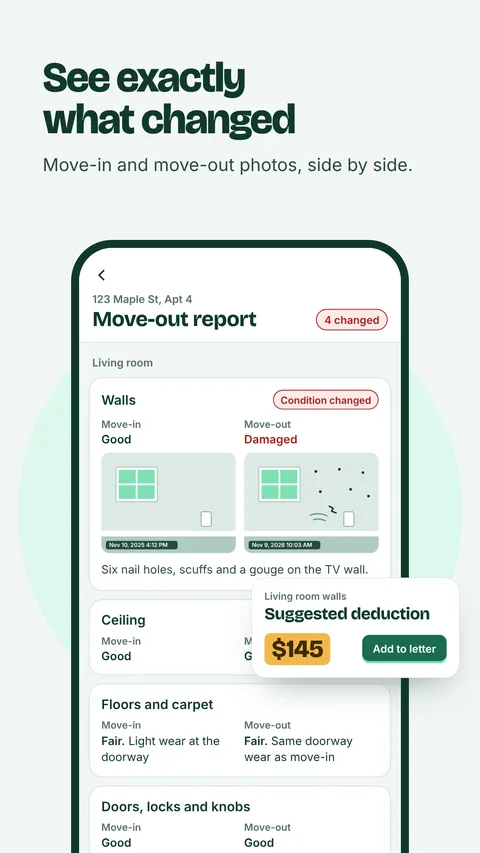
DepositDay walks you through move-in and move-out room by room, burns the date and time into every photo, shows what changed side by side, counts down your state's deadline, and writes the itemized deduction letter.
Start a free inspection
Common questions
Can a landlord charge a tenant for HOA fines?
Usually only if the lease makes the tenant responsible for HOA fines caused by the tenant's household or guests. An HOA's rules generally bind the owner and the association usually bills the owner, so passing a fine on generally depends on that lease clause.
Can a landlord deduct HOA fines from a security deposit?
It depends on the state. Texas and Arizona let the deposit cover charges the lease makes the tenant liable for. New York and Massachusetts limit deductions to a short list, and a fine isn't on it.
Who pays HOA fines, the landlord or the tenant?
The association usually bills the owner, because the HOA's rules generally bind the owner. The owner can generally pass a fine on if the lease makes the tenant responsible for fines caused by the tenant's household or guests and the fine is for something that happened during the tenancy.
Can an HOA fine a tenant in Florida?
Yes. Florida's HOA and condo statutes name tenants among the people an association can fine. A fine requires at least 14 days' written notice and an opportunity for a hearing before a committee, and it may not be imposed if the committee doesn't approve it by majority vote.
Does a Texas HOA have to give notice before a fine?
Yes, unless the owner was already given notice of the same violation under § 209.006 in the past six months. The association must first send the owner written notice by certified mail that describes the violation, says the owner is entitled to a reasonable period to cure a curable violation that isn't a threat to public health or safety, and says the owner may request a hearing on or before the 30th day after the notice was mailed. If the owner cures the violation before the cure period expires, a fine may not be assessed.
How do I dispute an HOA fine my landlord charged me?
Ask the landlord for the HOA's violation notice and fine notice, and check that the fine is for something you, your household or your guests did during your tenancy and that the HOA followed its notice and hearing steps. Then write to the landlord, name the charge and ask for the money back by a set date.
Related guides
General information, not legal advice. State and local rules differ and change. Read your state statute or ask a local attorney before you act. Deposit rules by state.